Silversea vs. Quark vs. Lindblad: How to Choose the Right Antarctica Expedition
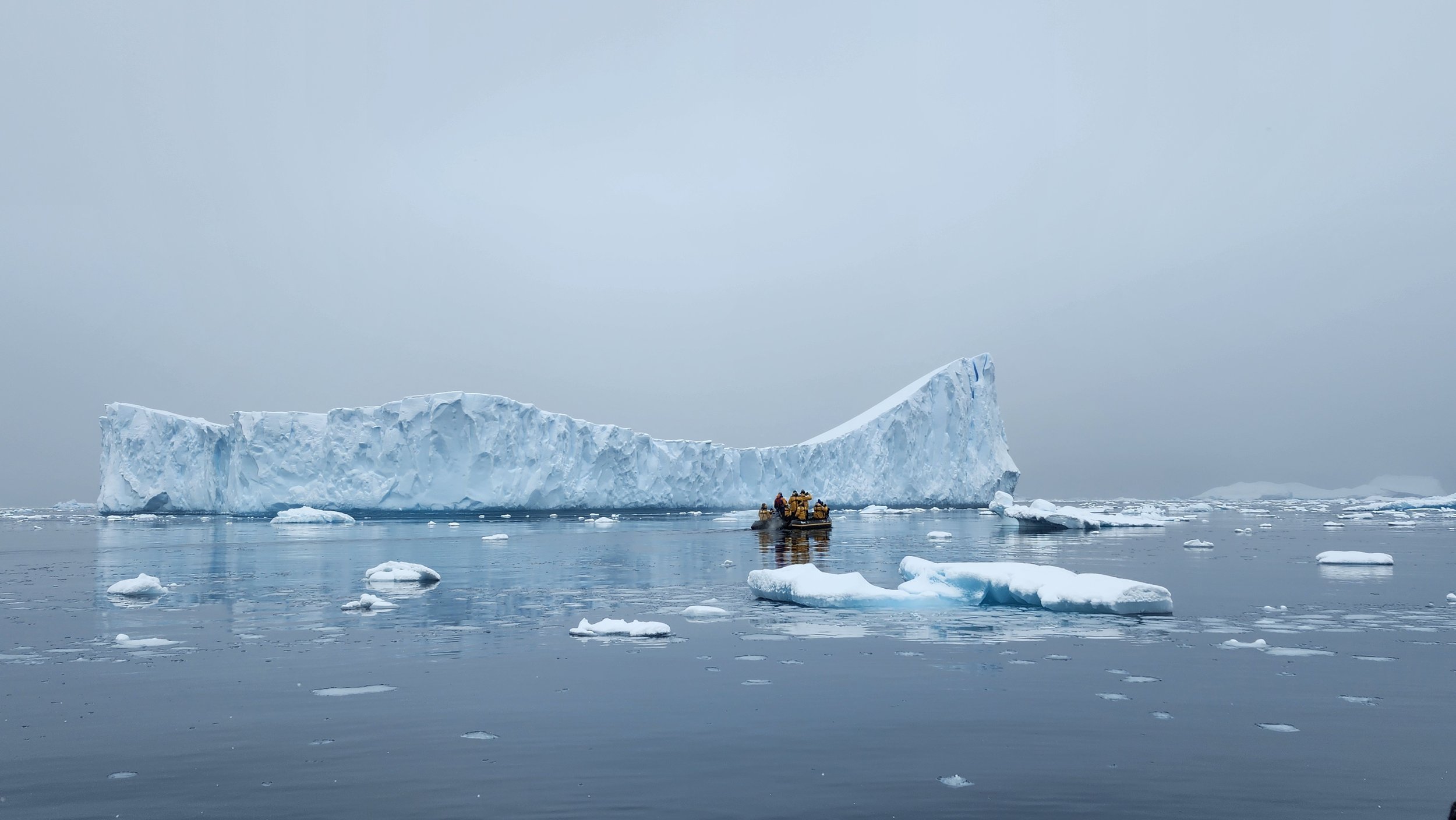
A glacier front along the Antarctic Peninsula, the kind of scene that opens most expedition days.
Choosing between Silversea, Quark Expeditions, and National Geographic-Lindblad is not simply a question of which Antarctica ship is the most luxurious. All three run serious expedition programs. The zodiac cruises, shore landings, and wildlife encounters are largely the same across all three; they're governed by IAATO rules that cap group sizes and landing numbers regardless of which ship you're on. What differs is not the wildlife or the landings themselves, but everything built around them, who is guiding you into a zodiac, what you return to on the ship afterward, and how the hours between landings are spent.
Silversea is the best choice for travelers who want Antarctica paired with spacious suites, butler service, refined dining, and the option to fly over the Drake Passage. Quark is my overall recommendation for many first-time travelers, because it holds an especially strong balance of comfort, polar expertise, and adventure, including helicopter flying if you choose the Ultramarine. National Geographic-Lindblad is the one to book for naturalists, science, wildlife photography, and a smaller, more communal atmosphere.
I have traveled to Antarctica myself, and I know how much the operator, the ship, the expedition team, and the route shape the trip. What follows is what each company does best, where the tradeoffs sit, and which expedition is most likely to suit the way you actually like to travel.
The quick answer
Choose Silversea for Antarctica delivered with the service, suites, and dining of a very good hotel.
Choose Quark for the widest range of adventure, and a comfortable ship that never lets you forget why you came.
Choose Lindblad for wildlife, science, photography, and time with genuinely exceptional naturalists.
For most first-time travelers I would begin with Quark. It offers the best overall balance of comfort, expedition access, and adventure. The exceptions matter, though. If luxury is not negotiable, Silversea is the better fit. If you read the lecture schedule before the deck plan, Lindblad may be exactly right. Operator is only half the decision. The month you sail changes what you actually see down there, and I have written that up separately in Best Time to Visit Antarctica: A Month-by-Month Guide.
What an Antarctica expedition actually feels like
You do not really talk while watching a penguin come into the world.
Paulet Island does not look like much from the water. It is a small, circular volcanic island near the northeastern end of the Antarctic Peninsula. From a distance it is little more than a dark cone of rock, snow pressed into its creases.
Then you get closer, and the entire lower slope is moving.
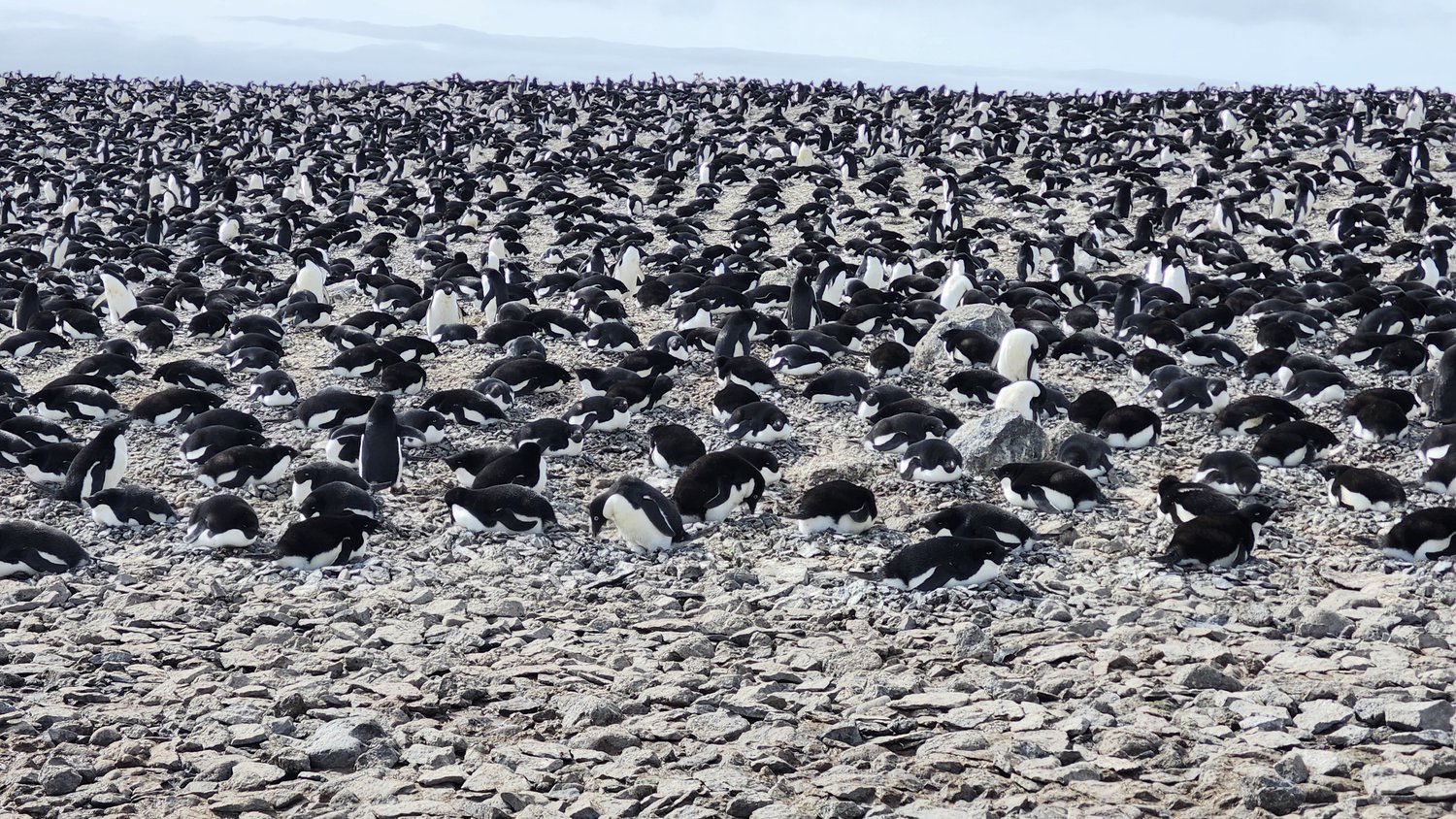
Part of the Adelie penguin colony on Paulet Island, roughly a hundred thousand pairs.
Adelie penguins nest there in numbers that stop making sense past a certain point. Somewhere around a hundred thousand pairs, counting matters less than simply accepting that there are penguins everywhere. Each one is sitting on an egg, defending a nest, stealing stones from a neighbor, or heading for the water with enormous purpose.
I was on the marked path when I noticed a small movement beneath one of the nesting birds. Not a shuffle. Something smaller. I watched for several seconds before I understood. A thin crack had opened in the egg. Then a piece of shell tipped loose, and there was something wet, exhausted, and entirely new.
A chick was hatching. I said something out loud, though I do not remember what. Two people nearby came over without asking why. Nobody said much after that.
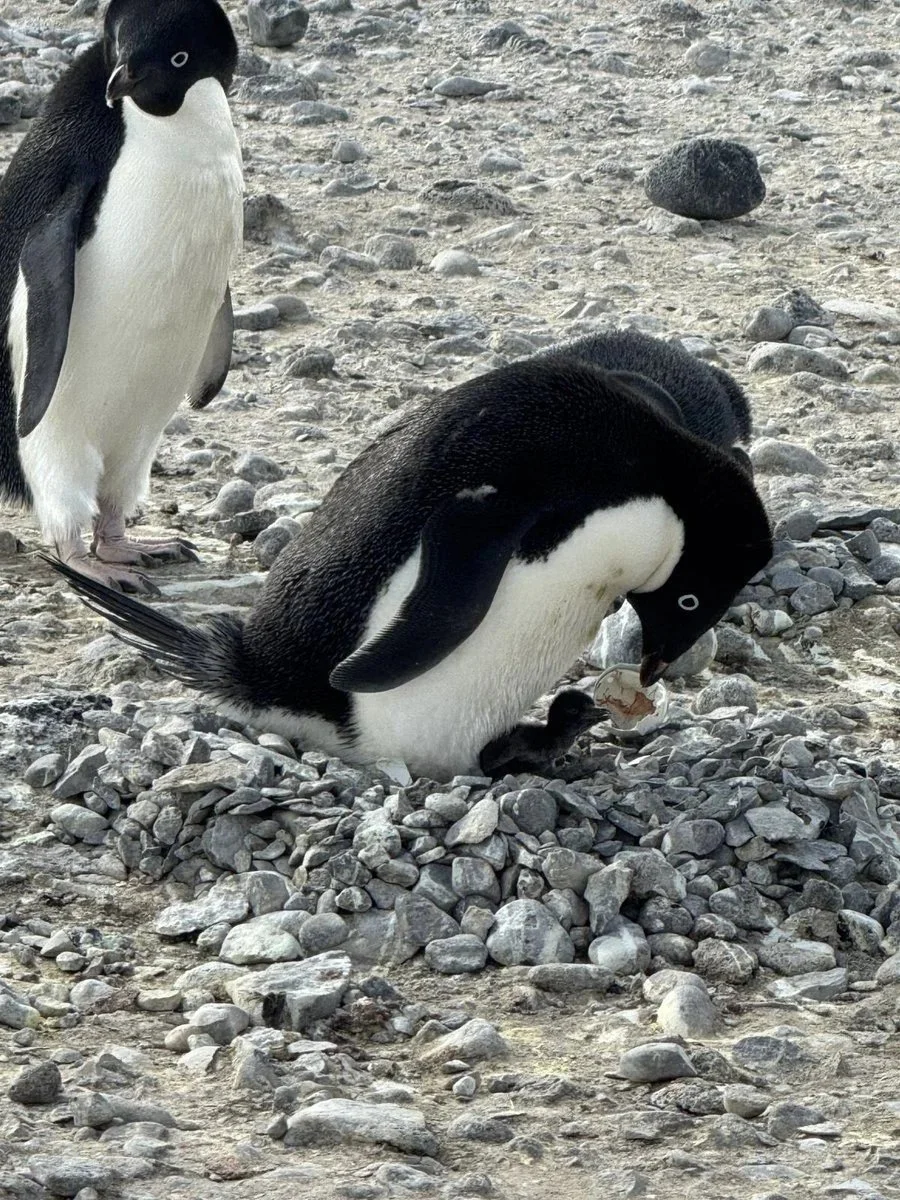
An Adelie chick and broken shell at the nest, the moment that made the trip.
Our team’s penguin specialist happened to be close, and quietly explained what came next. The parents would begin trading shifts, one guarding the chick while the other returned to the sea to feed.
Nobody scheduled that moment. Nobody could have. It happened because I was standing in that particular place for those particular ten minutes, and paying attention.
That, more than anything, is what I mean when I say expedition rather than vacation.
What an expedition actually is:
It is built around a plan that changes constantly, because ice, weather and wildlife do not follow the printed itinerary, and the good ones will tell you that on day one instead of pretending otherwise. It rewards attention. The people who saw the hatching were the ones looking down at penguins instead of out at the view, and that is true of most of what matters on a trip like this. It puts expertise next to you, not lecturing from a podium. It asks something of you. Cold hands, early mornings or late nights (thanks to the 23 hour daylight!), a schedule that can shift twice before breakfast. The reward is proportional to that.
What it is not:
It is not a show with a schedule. Nobody can promise you a hatching, a breach, a seal kill. The ships that imply otherwise in their marketing are overselling something nature does not agree to. It is not passive. You do not get the egg cracking open by staying at the back of the group or skipping the landing because it is cold out. It is not the same trip twice, even on the same ship, same season, same itinerary number. The whole draw is that nobody, including the crew, knows exactly what today will be. It is not measured well by comfort alone. A ship can get every detail of your suite right and still give you a flat day if you never left the lounge, and it can put you through a rough landing that ends up being the thing you talk about for years.
Silversea vs. Quark vs. Lindblad at a glance
Price tiers are relative, not exact. Most Antarctic Peninsula expeditions begin around 12,000 to 20,000 dollars per person. Luxury suites, fly-cruise programs, and longer South Georgia itineraries can reach 25,000 to 50,000 dollars or more.
First, the one rule that decides everything
Under Antarctica visitor guidelines, no more than 100 passengers may be ashore at one landing site at a time, and ships carrying more than 500 passengers are not permitted to land at all.
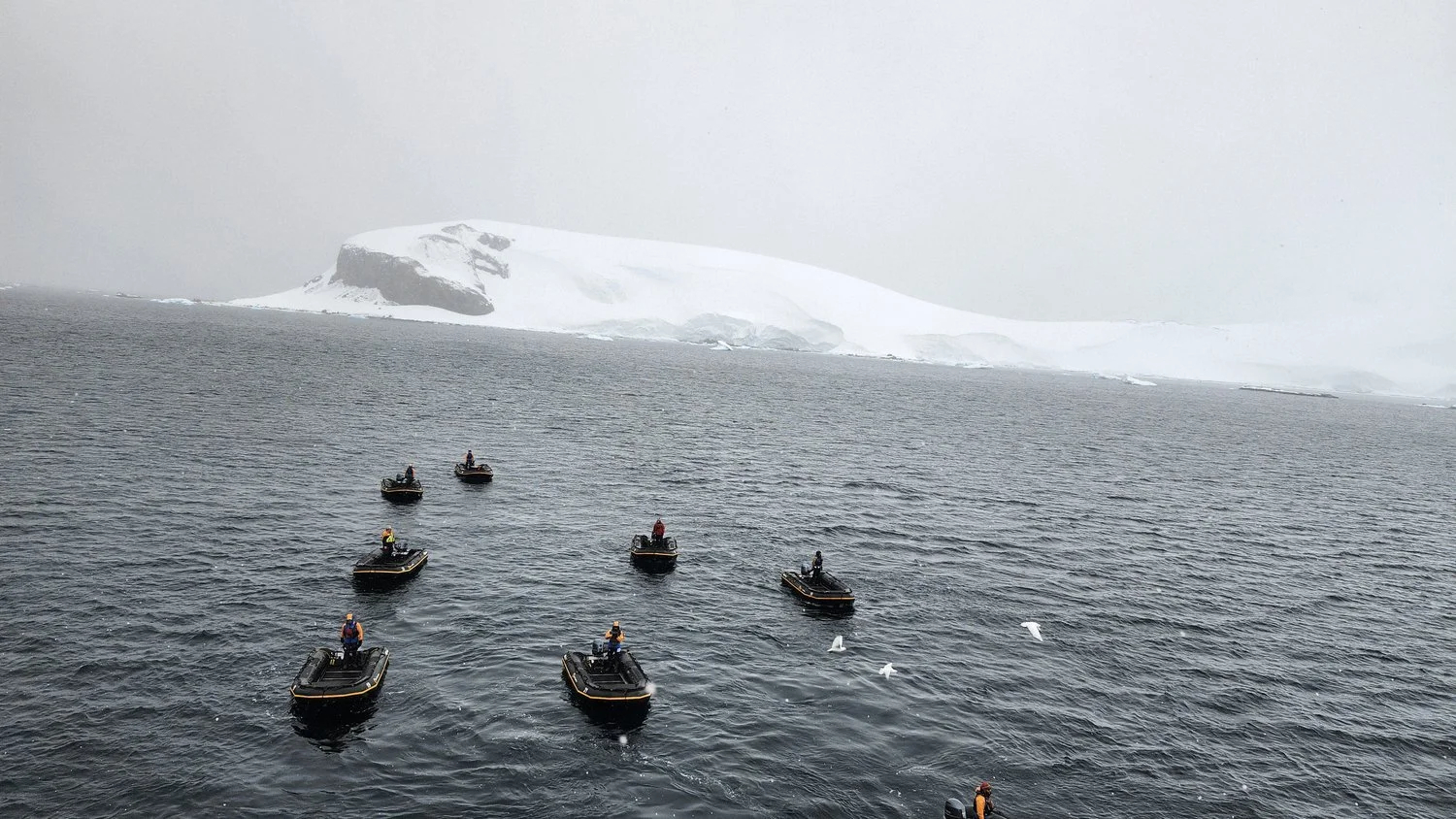
Zodiacs staging for a shore landing. IAATO caps each landing at 100 guests, which is why ships rotate groups.
Guest count therefore shapes the whole day. On a ship of close to 200, passengers are divided into groups. One group lands while another takes a Zodiac cruise, then the groups switch. On a smaller ship, everyone can often move through the day with fewer rotations.
That does not make the smallest ship the better choice. A slightly larger vessel may offer better stabilizers, more dining, larger cabins, a proper spa, or equipment such as helicopters. The point is not to find the smallest ship. It is to find the smallest ship that still gives you the comfort and facilities you actually care about.
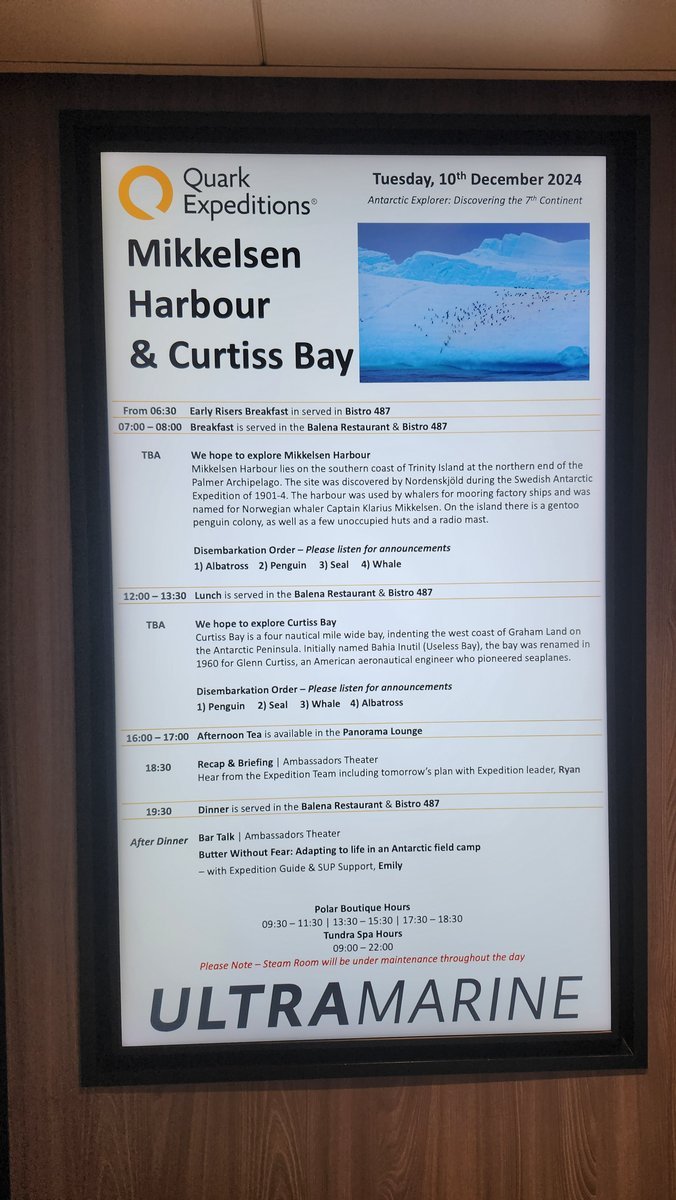
A daily program board aboard Ultramarine, with the disembarkation groups that keep landings within the limit.
Silversea carries the most guests of the three and offers the most polished time on board. Quark sits in the middle, with a larger expedition platform and an unusually broad range of activity. Lindblad’s newer polar ships carry fewer guests, which makes for a more intimate and more academic feel. All three deliver a real expedition. What differs is how the day feels while they do it.
Silversea: all-suite luxury and the easy way to skip the Drake
You return from a wet landing still in your parka, and the contrast is immediate. Outside it was wind, spray, ice, and wildlife. Inside Silver Endeavour there are quiet public rooms, attentive crew, and the sense that someone has already thought about what you might want next. The expedition happens outside. Step back through the doors and it becomes a very good hotel that happens to be built for polar water.
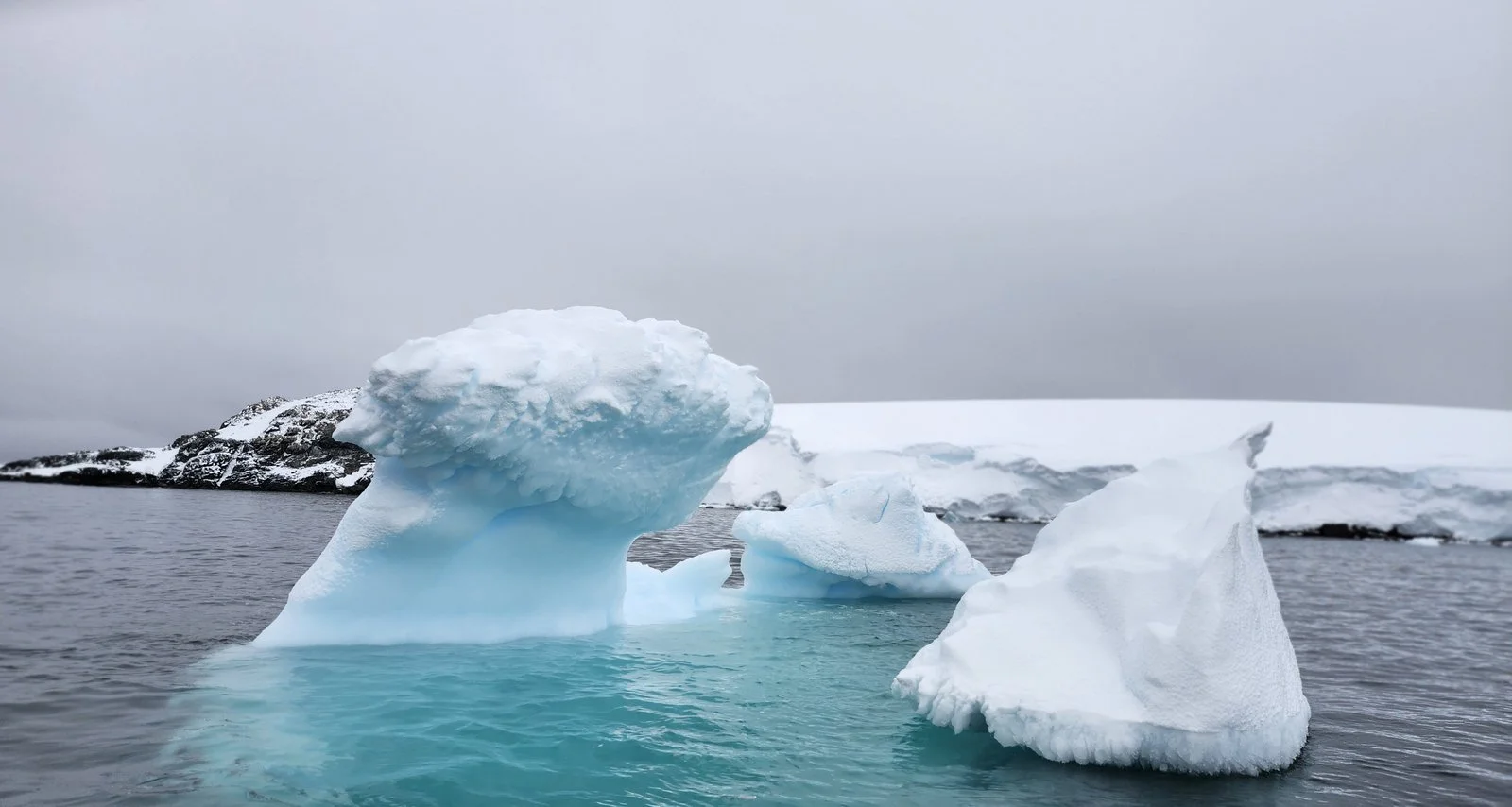
Sculpted blue ice on a still day along the Peninsula.
The ship
Silver Endeavour carries up to 220 guests and 207 crew. It is the largest ship I’d recommend for Antarctica , and also the most spacious on board. The all-suite accommodations begin near 355 square feet including the veranda, and every suite comes with a butler. Silversea also runs the smaller, classic polar ships Silver Cloud and Silver Wind, which still sail the traditional Drake crossing and suit travelers who want the brand on a more intimate vessel.
What is included
Even entry-level suites offer generous space, a private veranda, large windows, and a bathroom two people can share without negotiation. The butler sounds theatrical before the trip and becomes useful after several days of early starts and shifting plans. Dining runs across Atlantide, Il Terrazzino, La Dame, The Grill, and the Arts Cafe, more choice than on Quark ships or the National Geographic ships. Dining, many drinks, gratuities, expedition activities, and Wi-Fi are generally included, though the exact inclusions vary by fare and some premium experiences cost extra.
The tradeoffs
Silversea's ships are not for someone who wants to come home saying they roughed it. The proposition here was never hardship. It is Antarctica with as little comfort surrendered as the itinerary allows. And the comfort comes with a price tag.
Choose Silversea if comfort is not negotiable and you want the strongest suites, service, and dining of the three, or if flying over the Drake is a priority. It suits milestone birthdays, anniversaries, and honeymoons especially well.
Quark: the polar specialist with helicopters
You are still catching your breath from a helicopter flight or a polar plunge when someone hands you a hot drink at the top of the gangway. That is Quark in one gesture. The company works only in the Arctic and Antarctica. It does not spend half the year on warm-weather cruises and change the scenery when polar season arrives, and that focus shows in how confidently the days run.
The ship
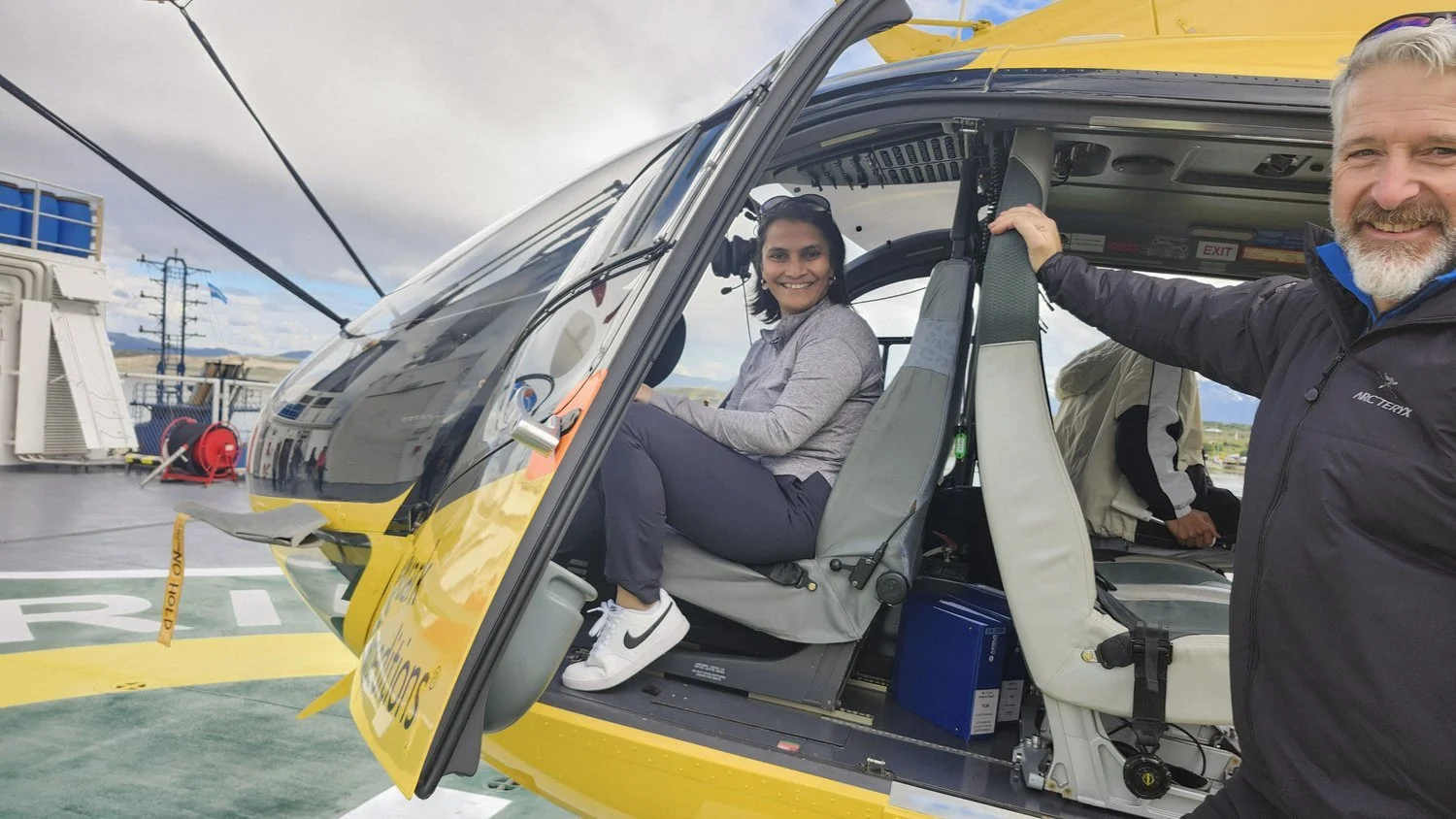
Quark's Ultramarine, the expedition platform that carries the two helicopters.
Ultramarine carries 199 guests,, and was built as a dedicated expedition platform. It has two twin-engine Airbus H145 helicopters, 20 quick-launching Zodiacs, four embarkation points, wide observation areas, two restaurants, a spa, and a sauna with floor-to-ceiling windows. It does not pretend to be a resort. It feels like a serious expedition vessel that is also comfortable enough that you are not quietly longing for a Four Seasons by day four. Quark’s polar fleet also includes the 144-guest Ocean Explorer and the 168-guest World Voyager, which joins in November 2026. Both reward a look if you want a smaller ship, but Ultramarine is the one with the helicopters.
Solo travelers and adventure

Helicopter flightseeing from Ultramarine, the feature that sets Quark apart.
The two helicopters are what most clearly set Ultramarine apart. Depending on the departure, the weather, and local permissions, guests may fly for sightseeing, land by helicopter, or join other heli-based outings. Quark’s dedicated Antarctica by Helicopter voyages currently include at least two flightseeing excursions and a helicopter landing in the fare. Helicopters reach ice shelves, mountains, and remote coast that no ship or Zodiac can. None of it is guaranteed, since Antarctica keeps a firm veto over every plan, but when conditions cooperate the range is something Silversea and Lindblad cannot match.
Depending on the voyage, optional activities may include kayaking, paddleboarding, and camping. Quark is also unusually thoughtful about solo travelers. Ultramarine and the Ocean Explorer have solo cabins, so a solo guest feels planned for rather than tucked into whatever remained. Comfort runs deeper than the adventure-first billing suggests. Every cabin has a private bathroom with heated floors, a detail that sounds minor until you come back from a wet landing in near-freezing wind and find the floor warmer than your entire emotional state.
Food and atmosphere
On the Ultramarine, dining centers on Balena Restaurant and Bistro 487. The Ocean Explorer features a main dining room on Deck 5 and an upper-level bistro on Deck 8. On the World Voyager, you have a main dining room for buffet and plated meals, along with more casual bistro or observation lounge dining areas. On Quark ships, the cooking is careful and the rooms have panoramic views, but the choice is narrower than Silversea’s. The mood is relaxed and social, with expedition staff often at the table. The ship is built to support the expedition rather than compete with it. Quark’s bet is that you would rather be out on the ice than choosing among five dinner venues, and for the right traveler that bet pays off completely.
Choose Quark if you want the broadest mix of adventure, polar expertise, and genuine comfort. It is particularly strong for active travelers, solo travelers, and first-timers still learning which part of the trip will matter most to them.
National Geographic-Lindblad: science and photography first
Dinner on a National Geographic-Lindblad ship tends to be communal. You might sit beside travelers you have not met, a naturalist, a photographer, or someone who spent the afternoon watching whale behavior, and the conversation runs well past the plates being cleared.
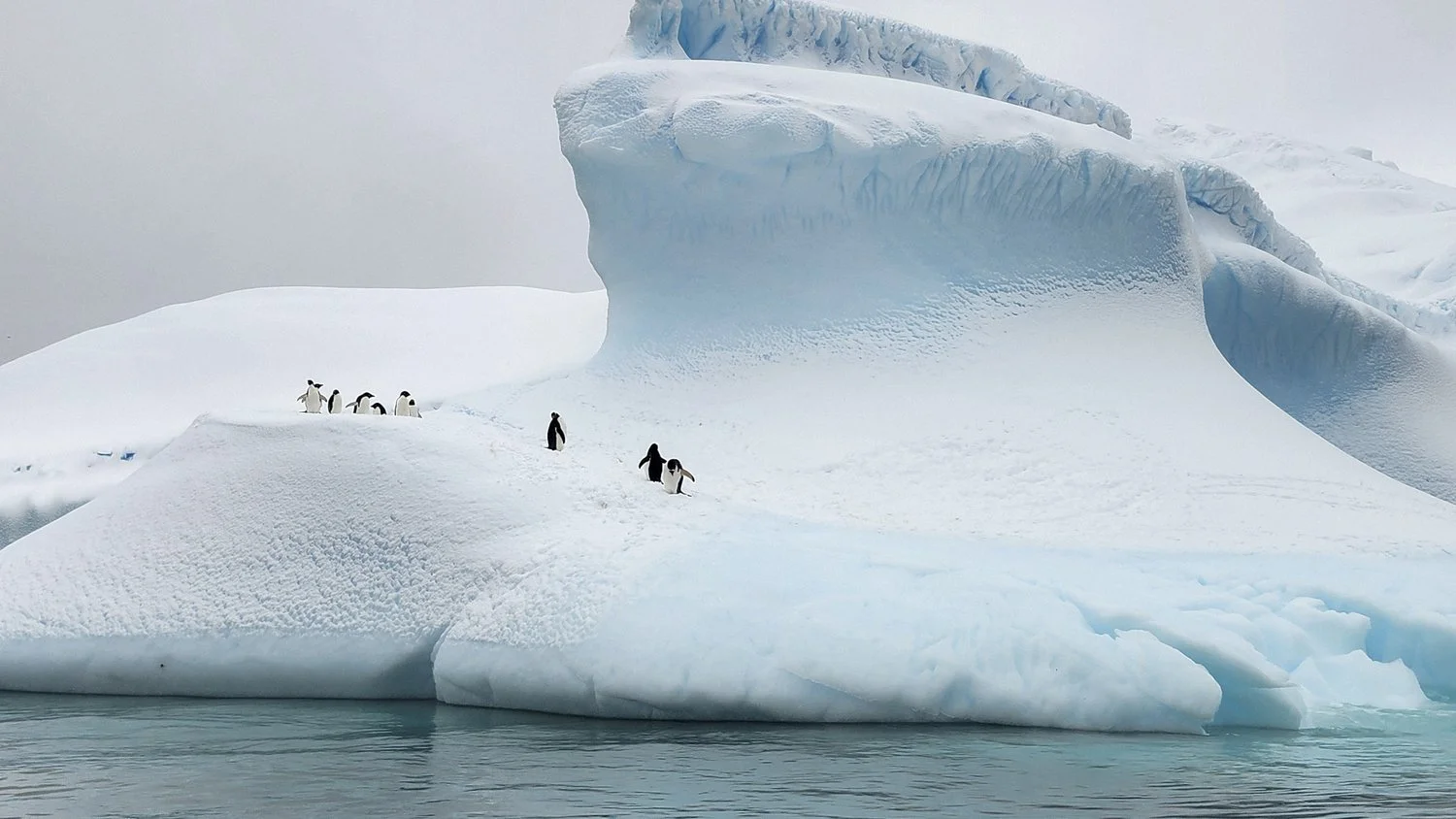
Penguins hauled out on blue ice, a common sight between landing.
The ships
National Geographic Endurance and National Geographic Resolution are modern polar ships with a PC5 ice class, which lets them push a little farther and sail a little earlier or later in the season than a PC6 vessel. Each carries up to 138 guests, about 126 in practice, with two dining venues, a spa, wide observation areas, outdoor firepits, and glass igloos on deck. The Scandinavian interiors are comfortable and quiet, with more than 10,000 square feet of glass keeping the landscape in view. The older polar ships, National Geographic Explorer and National Geographic Orion, remain in service and carry the same philosophy, though Endurance and Resolution are the newest and most appealing in the fleet.
The National Geographic program
This is where Lindblad most clearly separates itself. Teams may also include veteran naturalists, historians, undersea specialists, and visiting scientists. The undersea program is a particular pleasure. Specialists film life below the surface and bring the footage back on board, so guests see an Antarctic world that would otherwise stay hidden.
The heritage is more than marketing. Lars-Eric Lindblad led the first citizen-explorer expedition to Antarctica in 1966, helping invent modern expedition travel, and the company has worked the region ever since. That long memory shows in the calm, adaptive way its expeditions run when ice blocks a route or the wind turns.
The tradeoffs
There is no butler, no helicopter, and less emphasis on restaurant variety and suite size. Travelers choosing on luxury alone will prefer Silversea. Travelers chasing the widest range of physical adventure will prefer Quark. What Lindblad offers instead is depth of knowledge and attention. If science, wildlife, storytelling, and photography are not central to why you are going, the premium is hard to justify. If they are central, the slightly smaller cabin stops mattering rather quickly.
Choose Lindblad if you read the lecture schedule before the deck plan. It is the strongest match for travelers who want to understand Antarctica as deeply as possible, and it works well for curious families with children older than 8.
How to choose
The most useful move is to stop asking which company is best and start asking which details will most affect your enjoyment.
Silversea is the strongest choice for a spacious suite, attentive service, several restaurants, and a highly polished feel. Quark is genuinely comfortable in a more casual, expedition-first way. Lindblad is comfortable and well designed, especially aboard Endurance and Resolution, but traditional luxury is not the center of the product.
All three carry knowledgeable teams, but Lindblad makes science, natural history, and photography central. Quark brings particularly deep polar knowledge. Silversea carries respected naturalists too, though its expedition program shares the stage with the hospitality.
A traditional crossing runs about a day and a half each way and can be anything from glassy to genuinely rough. If that is not for you, then all three companies offer Fly-the-Drake itineraries. Flying saves time and skips a rough crossing, but flights to King George Island depend on Antarctic weather, so it removes one uncertainty rather than all of it.
The smallest ship is not automatically the best ship. The real question is how much comfort and infrastructure you will trade for a smaller guest count. Choose Silversea if you expect to spend real time in your suite. Choose Quark if you want a comfortable cabin with practical polar touches like heated floors. Choose Lindblad if the team, the ship size, and the program matter more to you than square footage.
Antarctica is expensive with any operator, and the final figure depends on ship, route, season, cabin, airfare, hotels, and whether you sail or fly. Quark often offers the strongest balance of cost, comfort, and access. Silversea commands a premium for its suites, service, and fly-cruise options. Lindblad's pricing reflects its smaller ships and deeply built-in naturalist and photography programs. The cheapest fare is not always the best value.
A classic Antarctic Peninsula route is usually the best introduction. Crossing the Antarctic Circle adds a sense of achievement but does not guarantee better wildlife. South Georgia is one of the great wildlife destinations on earth and deserves serious thought if you have the time and budget. Decide what you most hope to see before you choose a ship. The most beautiful suite on the wrong route is still the wrong trip.
You do not need to decide between Silversea, Quark and Lindblad before reaching out. That is the part I can help with.
Send me your rough dates, trip length, budget and what matters most to you, whether that is wildlife, adventure, photography, a beautiful suite or avoiding the Drake. I’ll compare the ships and departures that actually fit and narrow them down from there.
What about Ponant, Seabourn, Scenic, Aurora, Viking, HX, Atlas, and A&K?
Quark, Nat Geo Lindblad, and Silversea are the companies I return to most, because they stand for three clear approaches: traditional luxury, adventure-first exploration, and science-led travel. Depending on the traveler, one of the following can be an even better fit.
Ponant. French hospitality and unusual polar routes. Le Commandant Charcot is a Polar Class 2 icebreaker with onboard laboratories, built to reach well beyond the standard Peninsula. Best for experienced expedition travelers.
Seabourn. Venture and Pursuit sit between Silversea and Quark: purpose-built, all-veranda, up to 264 guests, 24 Zodiacs, kayaks, a 19-person team, and custom submarines.
Scenic. Scenic Eclipse is equipment-rich: up to 200 guests, an all-suite yacht feel, two helicopters, and a submersible. The helicopter and sub experiences usually cost extra and depend on conditions.
Aurora. Small, active, and less formal. Greg Mortimer, Sylvia Earle, and Douglas Mawson carry about 130 guests, with the smooth-riding Ulstein X-BOW hull and a serious program.
Viking Expeditions. Octantis and Polaris are large, up to 378 guests, with strong onboard science facilities and submarines, at the cost of a more structured, rotation-heavy day.
HX, formerly Hurtigruten Expeditions. A more accessible, informal approach built around education, citizen science, and sustainability, sometimes with reduced solo supplements.
Atlas Ocean Voyages. Yacht-style ships of roughly 200 guests. World Navigator and World Traveller sail in 2026 to 2027, with private charter flights between Buenos Aires and Ushuaia on traditional programs.
Abercrombie & Kent. Tailored programs aboard chartered ships, currently including Le Lyrial, generally limited to 199 guests, with a fully organized journey from arrival to departure. Strong for multigenerational travelers.
Frequently asked questions
What is the best Antarctica cruise line?
There is no single best line. Silversea is best for luxury and service, Quark for adventure and the strongest overall balance, and Lindblad for science and photography. The right choice depends on ship size, route, activities, the comfort you want, and how you like to spend the hours between landings.
How much does an Antarctica cruise cost?
Most well-run Peninsula expeditions begin around 12,000 to 20,000 dollars per person. Luxury suites, fly-cruise programs, peak dates, and longer South Georgia itineraries can reach 25,000 to 50,000 dollars or more. Airfare, insurance, activities, hotels, and cabin category all move the total.
What is the best time to visit Antarctica?
November brings dramatic ice, deep snow, and nesting. December and January have the longest days and busy penguin colonies, chicks included. February and early March are strongest for whales. There is no wrong month, but ice, wildlife, price, and mood all shift across the season.
Should you fly or sail the Drake Passage?
Sail if you have the time, can tolerate the chance of rough seas, and want the crossing to feel like part of the expedition. Consider flying if time is short or seasickness is a real worry. Flying saves time but still depends on weather, so it removes one uncertainty rather than all of it.
What size ship is best for Antarctica?
Ships of roughly 100 to 200 guests give the best balance of landing access and onboard comfort. Smaller ships move guests through activities more efficiently. Larger ships may offer better suites, restaurants, spas, stabilizers, and equipment. The best ship is the smallest one that still gives you the comfort you value.
How many days do you need?
A traditional Peninsula expedition usually runs about ten to twelve days, including the Drake. Shorter fly-cruise programs run six to eight. Adding South Georgia, the Falklands, the Antarctic Circle, or the Ross Sea means two to four weeks, sometimes more.
Is a luxury Antarctica cruise worth it?
Luxury earns the premium when suite comfort, dining, service, and the feel of the ship shape your enjoyment, and you will spend real time on board, especially during Drake crossings and weather days. Travelers focused almost entirely on landings and activities may find better value with an adventure-led operator like Quark or Aurora.
Can children travel to Antarctica?
Yes, though minimum ages and Zodiac rules vary by operator. What matters more is whether the child enjoys wildlife, changing plans, cold outings, and early mornings without the comforts of a family resort. Lindblad is often a strong starting point for a curious child over the toddler age, because learning is built into the trip.
Is Quark or Silversea better?
Silversea is better for spacious suites, butler service, refined dining, and fly-cruise options. Quark is better for helicopters, adventure, polar focus, and a more expedition-first feel. I recommend Quark for many first-timers, but Silversea wins when luxury and service are essential.
Is Lindblad worth the price?
Lindblad is worth the premium for travelers who value naturalists, science, wildlife interpretation, photography, and a smaller, communal atmosphere. Those focused on suite size, dining variety, or traditional luxury may find better value elsewhere. You are paying for depth of expertise, not a conventional luxury cruise.
How I Can Help You Choose
Antarctica is not difficult to book because there are too few options. It is difficult because there are too many very good ones, and they can look remarkably similar from a browser tab.
I have traveled to Antarctica myself. I know what the Drake feels like, how an expedition day actually unfolds and how much the ship, expedition team, route and season can change the experience.
Tell me your rough dates, how much time you have, your budget and what you most want from the trip. I’ll compare the operators and departures that fit, then help you sort through the questions that actually matter: Silversea or Quark? Fly or sail the Drake? Peninsula or South Georgia? Larger suite or smaller ship? Helicopters or naturalists? December or February?
I can also help compare cabin categories, understand what is included, secure limited-space activities, and plan the hotels, transfers, buffer nights and South America extensions around the expedition.
And because I work across multiple expedition companies, the goal is not to put you on whichever ship I happen to sell. It is to find the one I think fits you best. If I think an operator outside Silversea, Quark or Lindblad is the better choice, I’ll tell you that too.
There is no additional planning fee when you book the expedition through Sebastian Luxe Travel, and preferred pricing, onboard credit or other benefits may be available depending on the sailing.
Antarctica will take care of the unpredictable part. My job is to get the decisions we can control right.
Antarctica will take care of the unpredictable part. My job is to get the decisions we can control right.
About the author
Dee Swaminathan is an expedition travel advisor and guest contributor to Sebastian Luxe Travel. She has traveled to Antarctica firsthand and helps travelers understand the ships, routes, and practical choices that shape an expedition. She is certified with National Geographic Lindblad Expeditions and recognized as a Polar Pro with Quark Expeditions, which means travelers benefit from her deep expedition knowledge and firsthand insight into these extraordinary environments.
Through the Expedition Travel series she shares honest comparisons, firsthand stories, and steady guidance for Antarctica, the Arctic, South Georgia, the Galapagos, and other remote places.
Dee works in partnership with Kate Van Dell, founder of Sebastian Luxe Travel, planning expedition journeys from the first ship decision through every hotel, flight, transfer, and extension around the voyage.
Last updated July 2026