Best Time to Visit Antarctica: A Month-by-Month Guide
Last updated July 2026
Dee Swaminathan sailed the Antarctic Peninsula in December 2024 aboard Quark Ultramarine. She is a certified Quark Expeditions Polar Pro Specialist and an IAATO Antarctic Ambassador, and she returns to the Peninsula later this year, adding South Georgia and the Falkland Islands. She partners with Sebastian Luxe Travel on polar expedition planning.
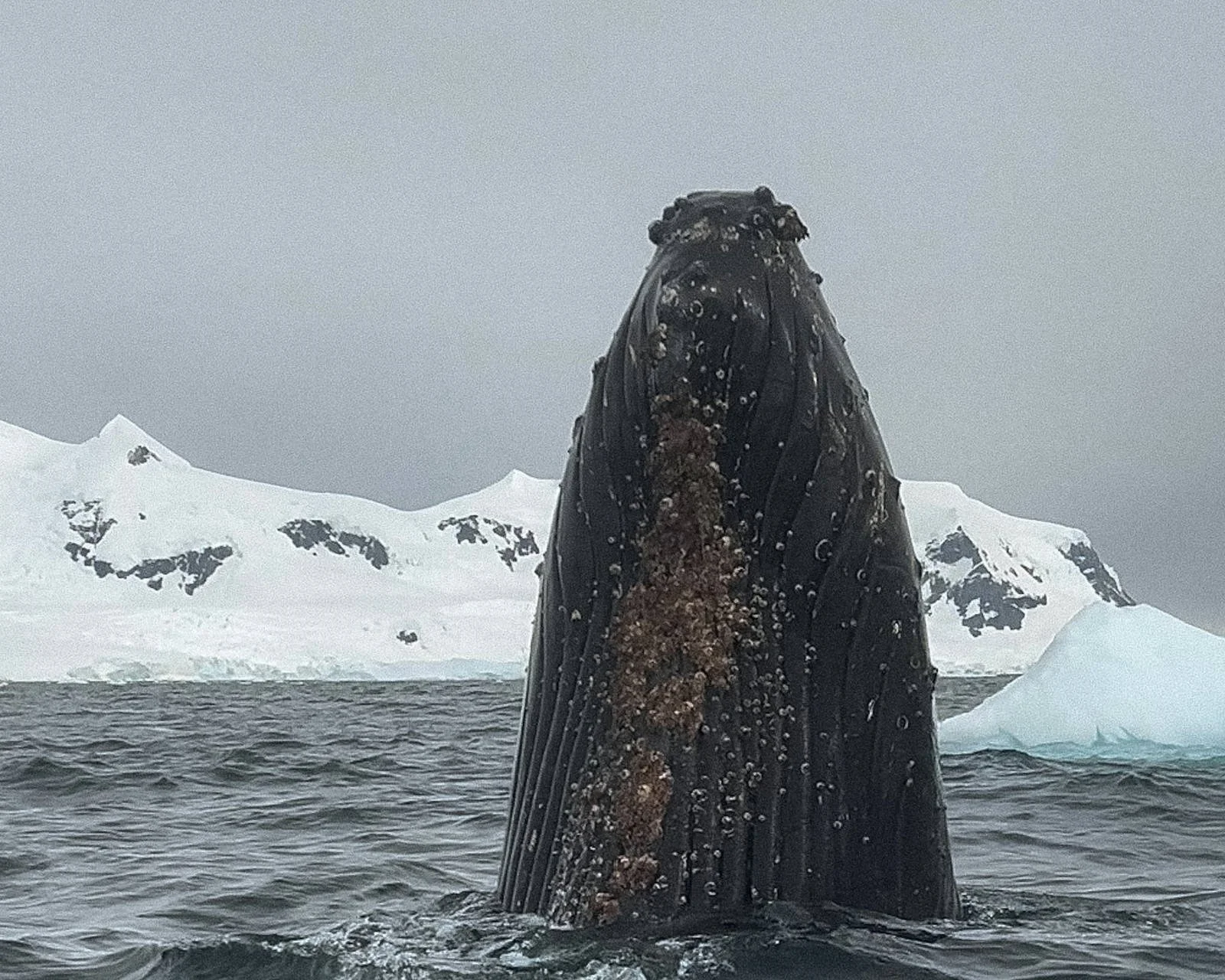
A humpback rising head-first out of the water, close enough to count the barnacles.
People ask me constantly what the best month is to visit Antarctica. I’ve learned to ask a question back before I answer: best for what?
Best for snow that looks like nothing has touched it since the last ice age? Best for downy chicks? Best for whales close enough that you can hear them breathe? Best for a quieter ship and a lighter bill?
There is no single best month. There’s a best month for you, and figuring that out is most of my job.
I’ll also say the part most seasonal guides leave out, because it’s the part that actually changes trips. The month is only one decision. The ship, the route, the cabin category, the operator’s landing style, whether you sail or fly the Drake, and how much buffer time you build in around the trip can affect the experience just as much. The right month on the wrong ship is still the wrong trip.
Here is the short answer. The long one follows.
The quick answer: best time by priority
| Your priority | Best window |
|---|---|
| Overall, for a first trip | December and January |
| Penguin activity | December through February |
| Whales | February through March |
| Deep snow and dramatic ice | November into early December |
| Better relative value | Early November, or March |
| South Georgia wildlife | Depends on the wildlife event you want. See the route section. |
| Holiday travel | December, booked well ahead |
Those are broad patterns. Your route, ship, and exact departure date can matter as much as the month.
Not sure whether to prioritize penguin chicks, whales, dramatic ice or a particular ship?
Tell me what you most want to see, how long you have and whether you would rather sail or fly the Drake. I’ll compare the routes and operators and shortlist the three departures that best fit your timing, travel style and wildlife priorities.
The Antarctic season at a glance
Antarctica travel happens during the Southern Hemisphere summer, roughly late October through early April. That window exists because sea ice retreats just enough during those months for expedition ships to reach the Antarctic Peninsula and the waters around it. Outside of it, the door is more or less closed. No commercial expedition ship is nosing into the Peninsula in July.
Early season runs late October into November. The continent is waking up. Snow is deep, ice is heavy, and the landscape looks the way you pictured it as a kid.
High summer runs December into January. Long days, the mildest temperatures of the year, and the busiest wildlife colonies.
Late season runs February into March, with a handful of operators pushing into early April. This is whale season, and it is also when penguin colonies start to look, and smell, a little rougher around the edges.
One honest caveat before I go further. Wildlife timing shifts year to year. It depends on the specific route, the landing sites an operator holds permits for, that season’s weather, ice conditions, and frankly a bit of luck. What follows are patterns built from years of watching this, not a guarantee stamped on a calendar.
Antarctica month by month
Late October: the edge of the season
A few operators start running trips in mid-October, but most of the fleet isn’t moving yet, so ship options are limited and itineraries tend to be more expeditionary by nature.
The landscape at this point is about as dramatic as Antarctica gets. Snow is deep, sea ice hasn’t broken up much, and some landing sites may simply be unreachable because the ice hasn’t opened. I’ve talked to guests who loved this, because it meant the ship’s route changed daily based on what the captain could actually reach, and that unpredictability was the appeal rather than a flaw.
Weather runs colder than the rest of the season and swings more. The Drake Passage carries no special guarantee of calm water this time of year, and if anything, early season crossings can feel a touch more unsettled.
Penguins are just returning to their colonies. You’ll see birds staking out nest sites and starting the early stages of courtship, but no chicks yet. Whale sightings are rare this early. Seals are around, often hauled out on ice floes and more visible against the deep snow than they will be later.
For photographers who want glaciers and ice, this is a strong month. The light is clean, the snow is unbroken, and the compositions feel austere in the way old expedition photographs do. Pricing tends to be lower.
Best for: photographers chasing untouched landscape, and travelers who don’t mind the itinerary changing under them.
October is also when some South Georgia itineraries start running, and that is for a reason. King penguins have an unusual breeding cycle. The Australian Antarctic Program puts the full cycle, including the pre-molt period, at roughly 13 to 16 months, so unlike most Antarctic penguin species their colonies never fully empty out and start over each year. Walk onto a beach at St. Andrews Bay or Salisbury Plain in October and you’ll find a mix of adults, half-grown chicks still wearing their brown, fuzzy oakum-boy coats from the previous season, and birds incubating new eggs, all in the same colony at the same time. It is a genuinely different sight from the tidy, single-stage colonies you see on the Peninsula.
October is also the start of elephant seal breeding season at South Georgia, and that is the real draw for early-season departures there. Bull elephant seals, some of them enormous, haul out and fight for control of beaches and the females on them. The fighting is loud, physical, and not what you’d expect from an animal that spends most of its life looking half asleep. Operators running October South Georgia trips lean on this directly, and on the fact that the island hasn’t yet seen its main wave of visitors.
November: big ice with more operational reliability
November is where the season really opens up, and it has become one of my favorite months to recommend to first-timers who also care about photography.
Snow and ice are still substantial, so the landscape keeps that late-October drama, but operators are running fuller schedules and more landing sites are typically reachable. Depending on species and location, this is when courtship is in full swing: penguins building nests out of pebbles, serious squabbling over the best real estate, and in many colonies the first eggs of the season.
Seals are commonly seen resting on ice floes, and you’ll likely spot crabeater or Weddell seals during Zodiac cruises. Whale sightings are possible in November but not at their peak. I wouldn’t set a client’s expectations around whales this month.
The Drake does what it wants. November crossings can be rough or glassy calm, and I’ve seen both in the same week of different years. If you’re flying the Drake to save time, understand that flights to and from King George Island are weather-dependent in every month, and shoulder-season conditions can make that a bigger factor to plan around. I tell clients flying the Drake in November to budget for a delay and to assume they may end up with one less day on the continent.
Best for: travelers who want deep snow and heavy ice with more operational reliability than late October, and photographers who want colony behavior alongside landscape.
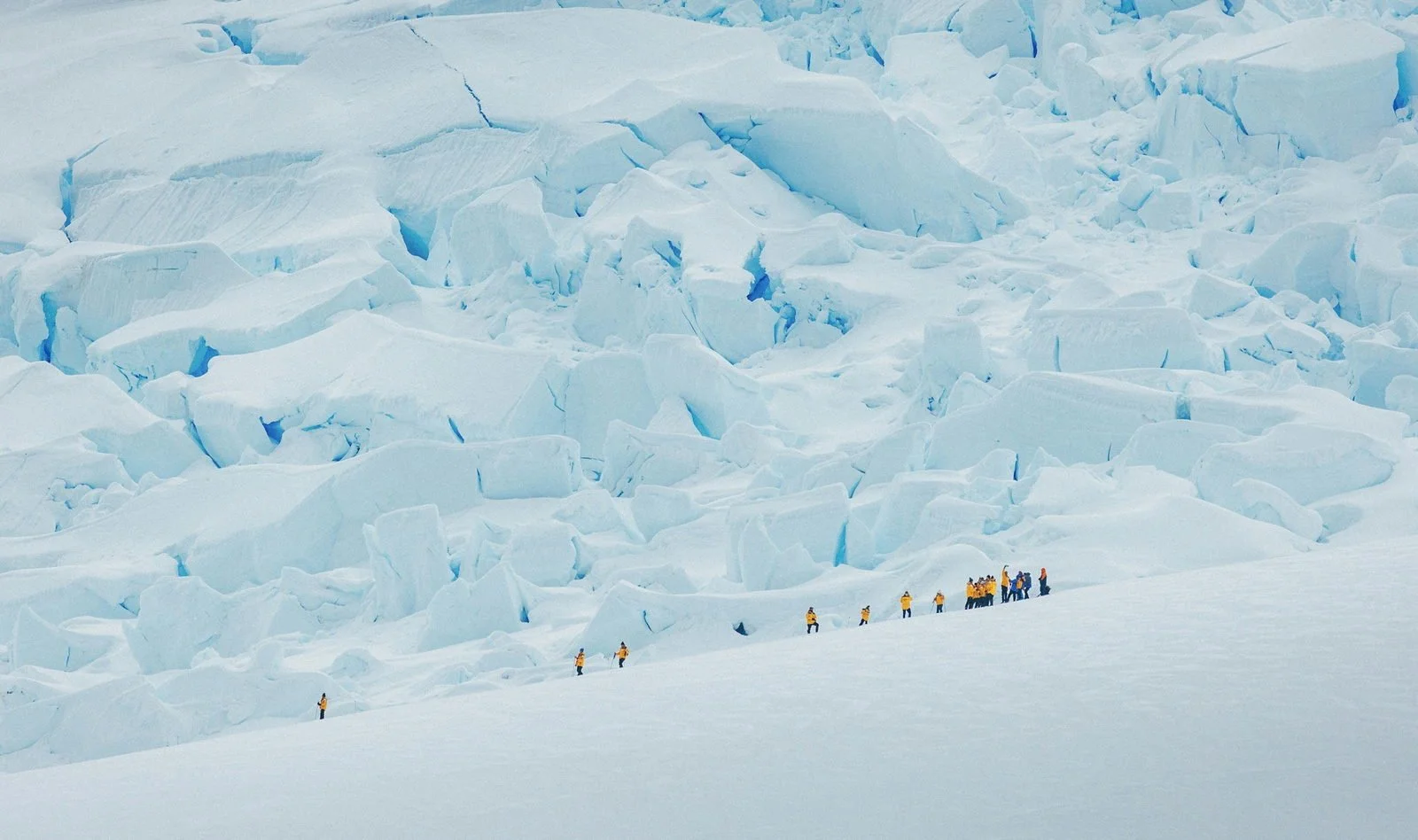
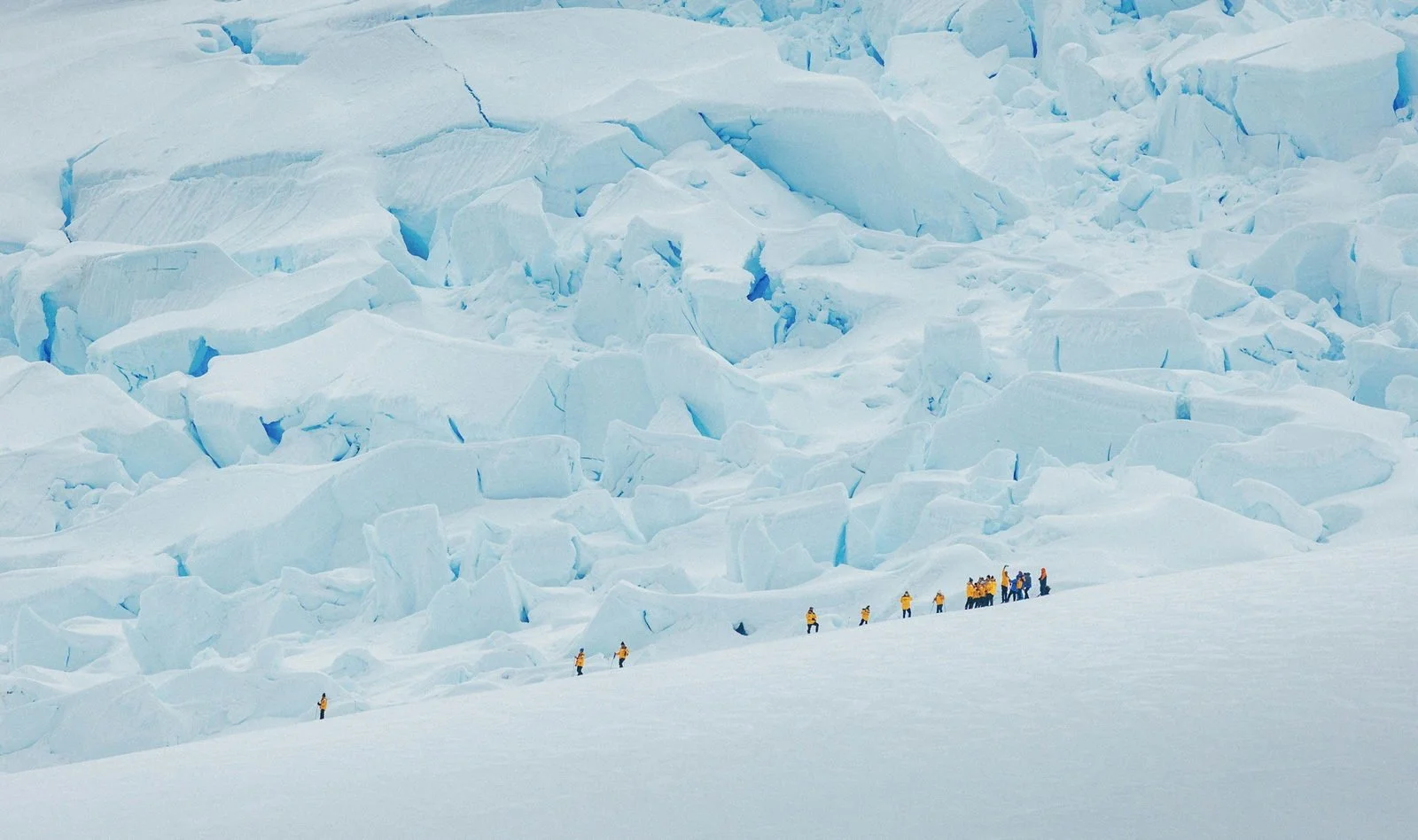
Early-season snow depth on the Antarctic Peninsula. The line of passengers along the lower right gives the scale of the icefall behind them.
December: the classic Antarctica most people picture
December is the month I went, and it’s the month I recommend most often to people who have never been.
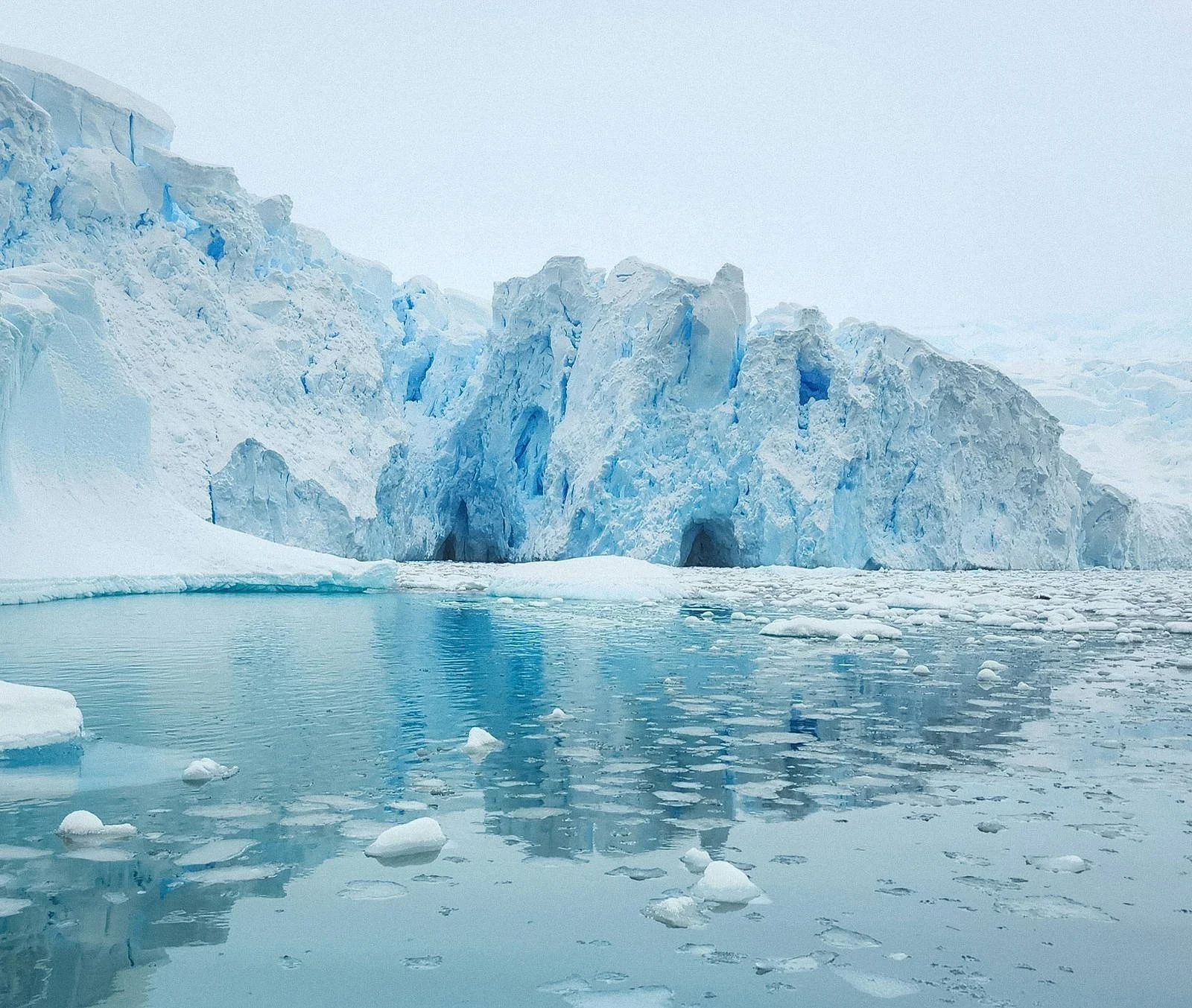
Early-season snow depth on the Antarctic Peninsula. The line of passengers along the lower right gives the scale of the icefall behind them.
The days stretch long, temperatures are the mildest they have been so far, and penguin colonies are at their loudest and busiest. Depending on species and location, this is prime time for nest building, egg incubation, and in some colonies the very first chicks.
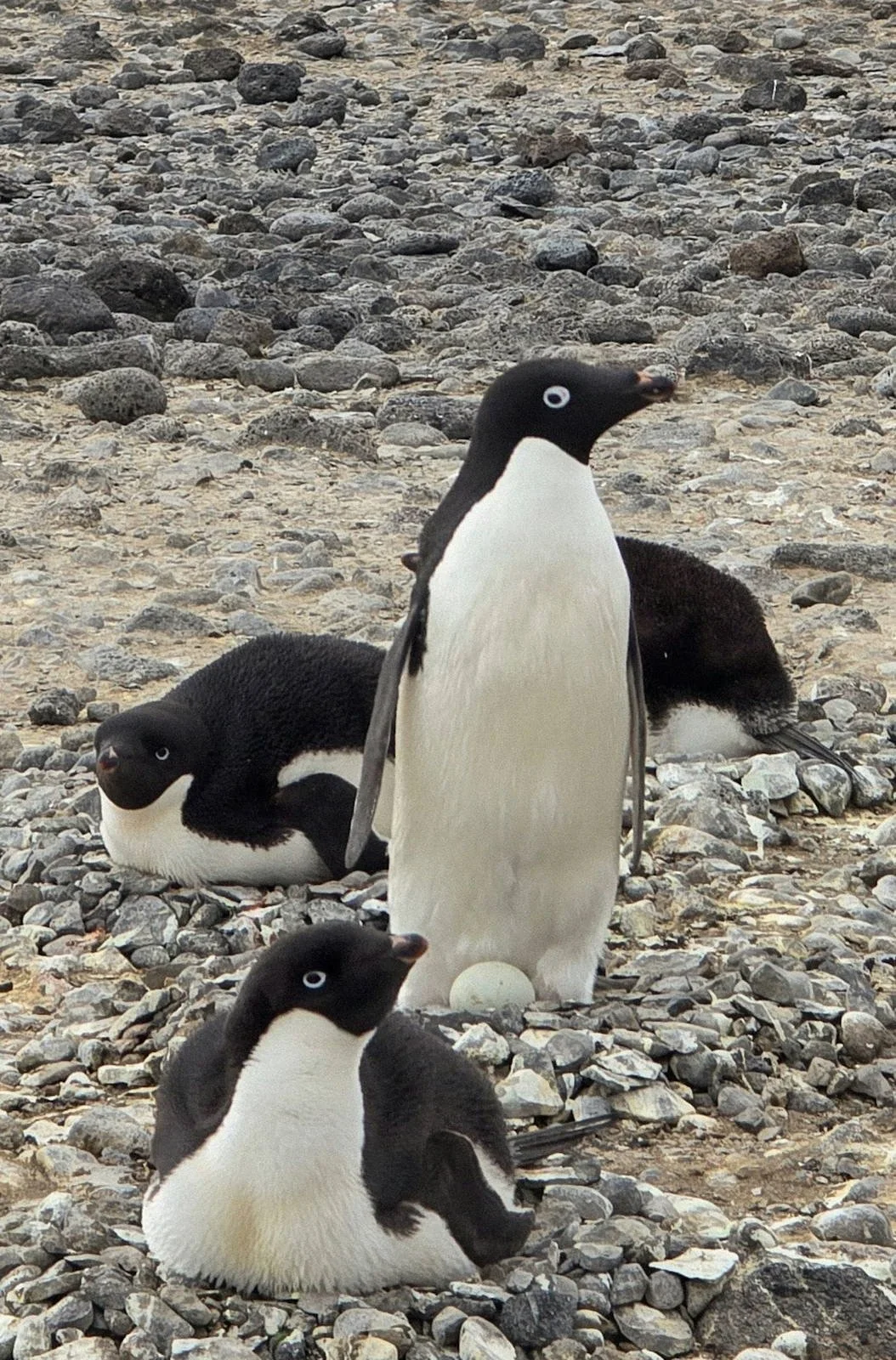
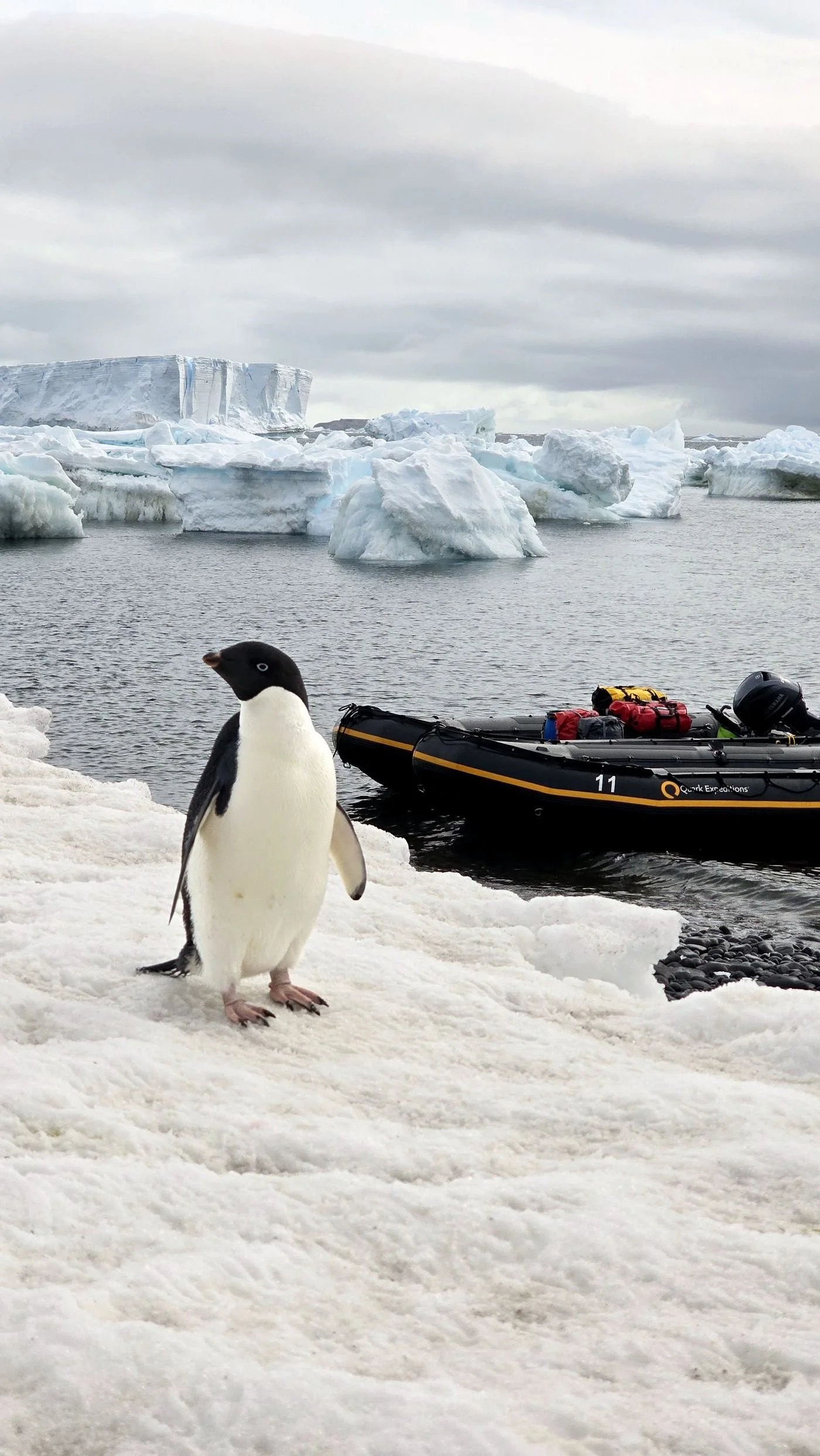
Adélie penguins on the nest in December, with an egg visible at the center bird’s feet.
I sailed in mid-December, and what I remember most is the penguins. Gentoos had worn actual paths into the snow, little penguin highways running from the colony down to the water, and at the shoreline the penguins would line up single file like they were waiting for a bus, then one would finally commit and jump, and the rest would follow in a rush. One of our guides called it the group decision, because apparently no individual penguin wants to be the first one in the water when a leopard seal might be waiting. I watched that same scene play out at four different landings and never got tired of it.
I’ll be honest about the whales, because honesty here matters more than hype. We saw some every single day. A few humpbacks came close to our Zodiacs, and we saw several flukes. But nobody was breaching and nobody was putting on a show. If whales are the reason you’re going, December is not guaranteed to deliver the encounters people picture from wildlife documentaries. That tends to be a February or March thing.
Departures around Christmas and New Year are the most popular and most expensive stretch of the entire season. Cabins book out early, sometimes a year or more ahead for the better ships. If you want to spend Christmas Day watching penguins instead of unwrapping presents, start planning early.
Best for: first-timers, families traveling over the holidays, photographers who want long light and busy colonies, and anyone who wants the version of Antarctica they have already seen in photographs.
January: the most balanced month on the calendar
January is high summer, and if I had to pick the single most balanced month, this is probably it.
Chicks that started appearing in December are more visible and more active in many colonies, wobbling around and demanding food from exhausted parents. Seal activity continues steadily. Whale sightings pick up as the month goes on, more consistently than December, though February still tends to edge it out.
Temperatures are about as mild as Antarctica gets, and sea ice has generally opened up further, which can mean access to more landing sites and channels depending on your itinerary. This is also one of the highest-demand months of the year, especially in the first half, and pricing sits close to December.
Best for: travelers who want a bit of everything, chicks and whales and mild weather, without narrowing in on one priority.
February: the month I point whale-focused travelers toward
Feeding activity in Antarctic waters tends to ramp up here, and whale sightings generally become more frequent than earlier in the season. Humpbacks in particular are often more active. Whale encounters can become much more frequent in February, and some sailings experience extraordinary feeding, breaching, or curious approaches. None of those behaviors is guaranteed.
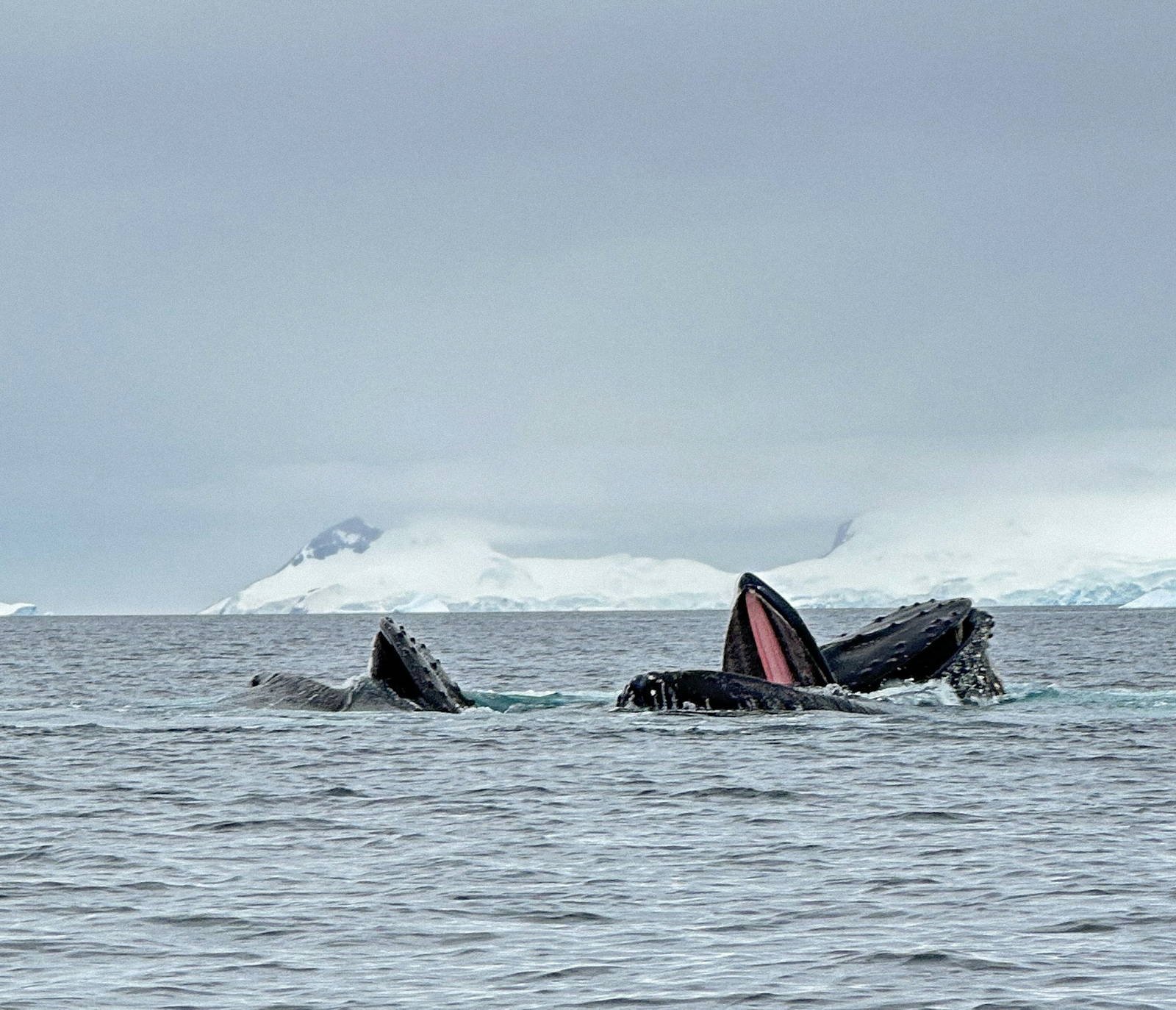
Humpbacks lunge feeding at the surface. This is the behavior that makes February and March the strongest whale months, and it is exactly what cannot be promised in advance.
Penguin chicks are bigger and louder now, and in a lot of colonies you’ll start to see the early stages of molting, when adults look ragged and disheveled as they shed old feathers for new ones.
The landscape itself starts to shift. There is more exposed rock at many landing sites and less of the unbroken snow blanket you would see in November or early December. Some clients find that less picturesque. I find it honest. It is a different Antarctica, not a lesser one.
Sea ice is generally at its most open by this point, which can improve access to certain sites, though weather still has the final say on any given day.
Best for: travelers who care more about whales and active wildlife than deep snow, and anyone who wants slightly warmer conditions on deck.
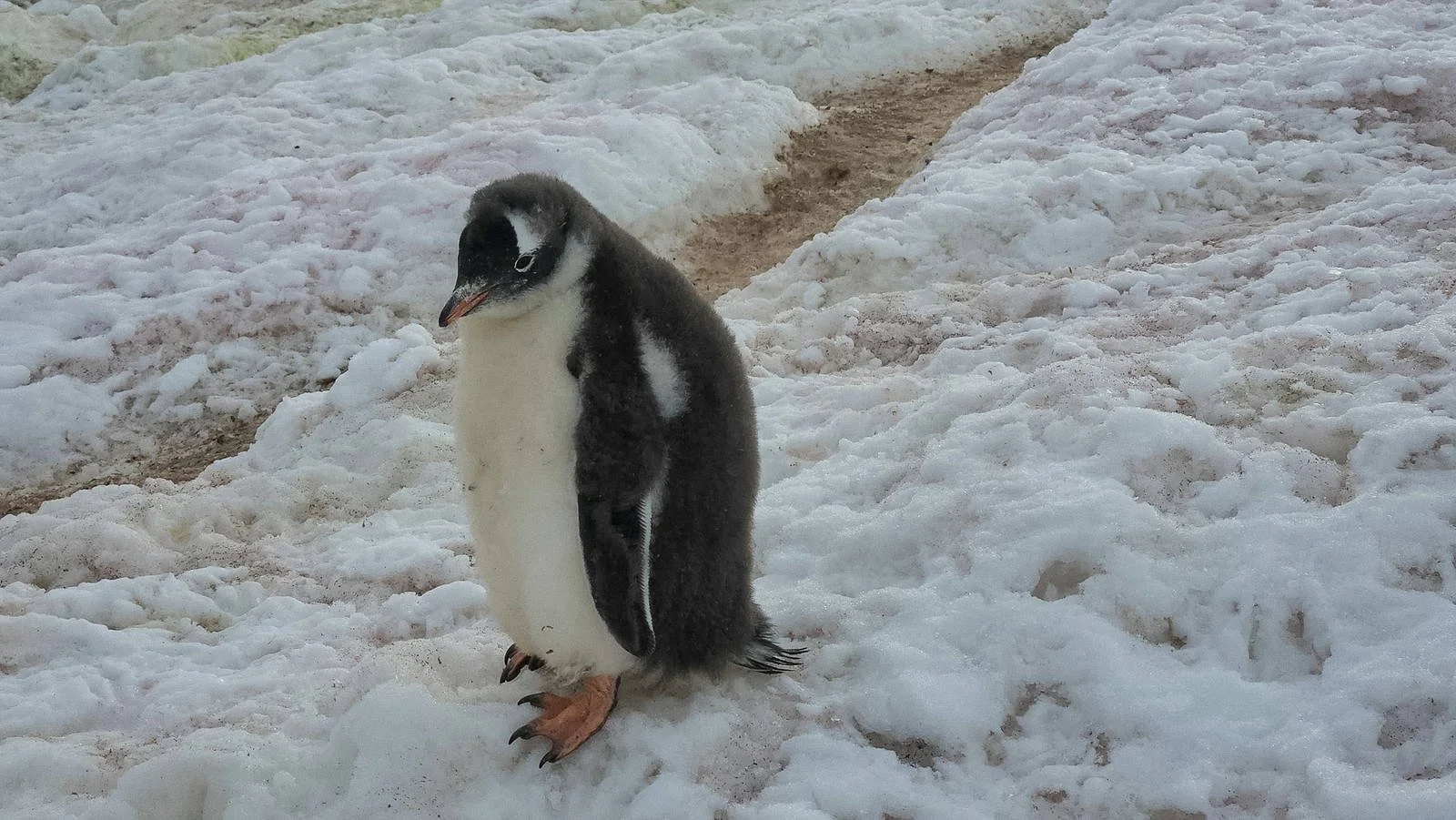
A gentoo chick beside a penguin highway late in the season, when the snow has gone gray and the paths have worn down to bare ground.
March: underrated, and often the best whale month of the year
Whale activity can be excellent in March, sometimes the best of the entire season, because animals have spent months feeding in these waters and are often easier to find.
Penguin colonies, meanwhile, are past their prime in terms of tidiness. Chicks are older, many are molting, and colonies can be loud, messy, and frankly a little pungent by this point in the season. I say that with affection. It is part of the honest picture of what a colony looks like at the end of a breeding season, not the sanitized version.
The light changes too. The sun sits lower in the sky for longer stretches of the day, and photographers who have been in both December and March will often tell you March gave them the better images, just for different reasons: warmer tones, longer shadows, more drama in the sky.
Weather can turn more unsettled again as the season winds toward its close, similar in unpredictability to the early season though for different reasons. Some operators drop pricing here to fill remaining cabins, so it can be a good month for value if your schedule is flexible. As in November, fly-the-Drake itineraries are more exposed to weather delays at this end of the season.
Best for: whale-focused travelers, photographers chasing dramatic light, and anyone comfortable with a rougher, more lived-in version of the wildlife experience.
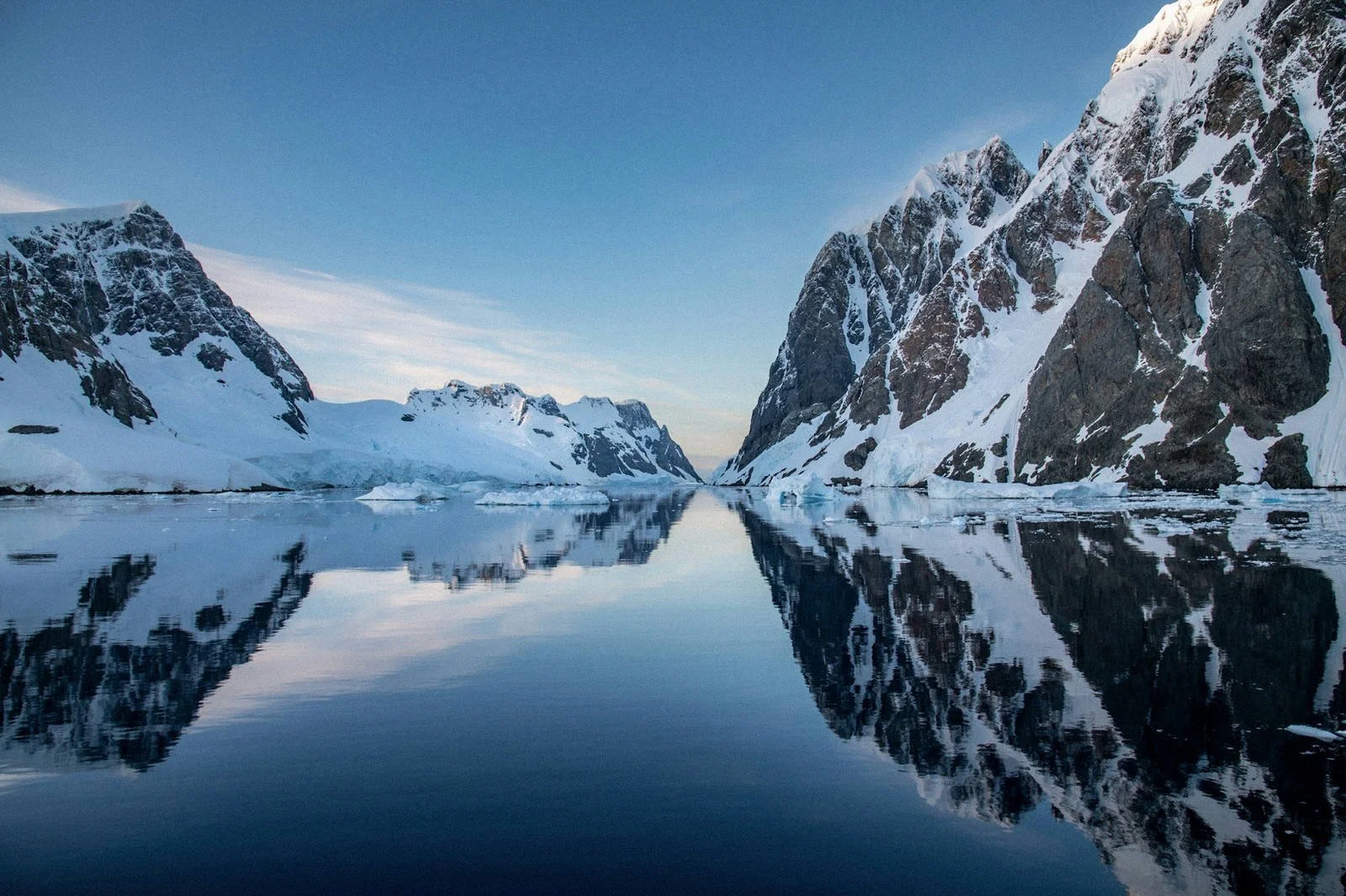
Later in the season, with more exposed rock and far less snow cover. Low light of the kind photographers travel to March for.
Early April: not a first trip
April is not the standard Antarctic Peninsula season. Most ships have wrapped their programs by the end of March, but a handful of operators run itineraries into early April, and occasionally as late as mid-April, depending on the route and that year’s conditions.
This is very late season. Weather variability picks back up, and operators need more flexibility built into these itineraries because conditions are less predictable this far along. It can appeal to travelers chasing an uncommon itinerary or better pricing, but I wouldn’t recommend it as anyone’s first trip to the continent. Save early April for a second or third visit, once you already know what a normal Antarctic season looks like and can appreciate how this one differs.
Best for: repeat visitors and travelers specifically looking for an unusual, late-season itinerary.
Season summary
| Month | Weather and ice | Penguins | Whales | Seals and birds | Best for | Watch-outs |
|---|---|---|---|---|---|---|
| Late October | Cold, heavy snow and ice, some sites unreachable | Arriving, early courtship | Rare | Seals on ice floes, birds returning | Photographers wanting raw, untouched landscape | Limited ship options, more itinerary changes |
| November | Deep snow, more sites opening up | Courtship, nest building, first eggs | Possible, not peak | Seals on ice, early birdlife activity | First-timers who want big ice and colony behavior | Drake unpredictability, weather-dependent flights |
| December | Milder, long days | Nesting, first chicks in places | Present, not peak | Active seals and birds | First-timers, families, holiday travel | Highest demand and pricing, book early |
| January | Mild, more open ice | Chicks visible and active | Increasing through the month | Steady seal and bird activity | Balanced wildlife and mild conditions | High demand, especially early month |
| February | Milder, more open water and rock | Larger chicks, some molting | Strong, often peak | Consistent seal and bird sightings | Whale-focused travelers | Less snow cover at some sites |
| March | More unsettled again | Older chicks, colonies messier | Excellent, often best of season | Steady, some birds departing | Whale lovers, photographers | Weather turning more variable |
| Early April | Highly variable | Late season, colonies winding down | Variable | Limited compared with peak season | Repeat visitors, unusual itineraries | Few operators running, less predictable |
Best month for penguins, whales, photography, value, and families
If you already know what you care about most, start here.
Best month for penguins and chicks
Late October through November is courtship and nest building. December into January is when eggs hatch and small chicks start appearing, with timing varying by species and location. By February and into March chicks are larger, some are molting, and colonies look considerably rougher than they did in early summer. For the classic downy-chick images, aim for December through February.
Best month for whales
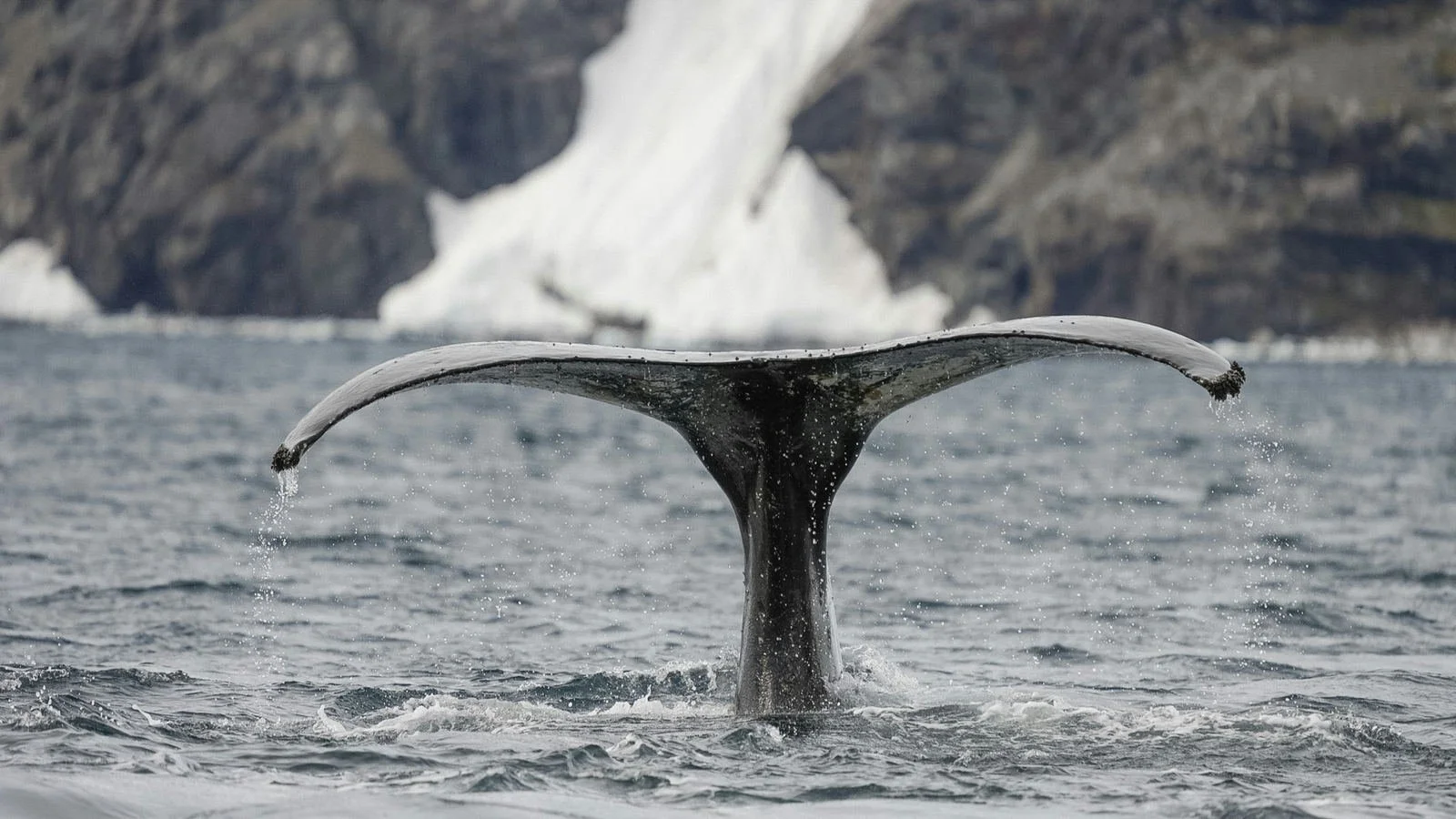
A fluke going down. Dee saw whales every day of her December sailing, mostly like this rather than breaching.
Whales are present from early in the season, but sightings generally improve as it goes on. January picks up. February and March are typically the strongest, because animals have had more time feeding in these waters. If whales are the single reason you are going, do not book December.
Best month for seals and birdlife
Seals are visible throughout, though behavior shifts by species and location. Crabeater and Weddell seals are commonly seen hauled out on ice. Leopard seals show up hunting near penguin colonies, often right at the water’s edge where those penguin highways lead. Fur seals and elephant seals are more associated with South Georgia than the Peninsula itself. Skuas, petrels, albatrosses, and terns are part of the experience all season, with nesting and feeding activity varying by location and timing. Skuas in particular hover around penguin colonies, and if you watch closely you will understand why. Nature isn’t gentle down there.
Best month for photography
November for ice and landscape. December or January for wildlife paired with very long light. March for whales and low-angle, dramatic light. Photographers who have shot both December and March often prefer March’s images, and neither of them is wrong.
Best month for value
Early November or late March into early April. The savings come with trade-offs: more variable weather early on, ice that can limit landing sites, less snow cover by late season, and a general need for flexibility in your expectations.
Best month for families
December, because school holidays and the season’s mildest, longest days line up. That alignment is also why it is the most expensive and fastest-selling window of the year, so families generally need to plan a year or more out to get the cabins they want on the ships worth wanting. More on timing school-break trips: when to book school break travel →
Why your route changes the answer
Here is what trips up a lot of first-time planners. Antarctica isn’t one itinerary. The month you choose matters, but so does the region, and those two decisions are tangled together more than people expect.
Antarctic Peninsula
The classic first Antarctica trip, and the route with the broadest operating season, generally late October or November through March, with a few operators starting in mid-October and a few pushing into early April. It is the go-to for travelers who want penguins, icebergs, Zodiac cruising, and actual landings without committing to a longer expedition. December through February is the most balanced stretch for first-timers. November leans more ice-heavy and dramatic. March is strong for whales.
South Georgia
Usually paired with the Falklands and the Peninsula on longer itineraries, often 17 to 23 days or more. It might be the single greatest wildlife destination most people ever set foot on. King penguin colonies that stretch further than you can comfortably fit in one frame, elephant seals the size of small cars, fur seals, and albatross colonies that make the birdlife on the Peninsula look sparse by comparison. Best season runs November through February. Early season brings dramatic elephant seal breeding activity. December and January are excellent for king penguin colonies and chicks. Worth noting: South Georgia isn’t technically part of the Antarctic continent, but it is very much part of the trip when people say they are going to Antarctica.
Falkland Islands
Typically bundled with South Georgia and Antarctica sailings. The Falklands add gentler landscapes, strong birdlife, several penguin species, and a cultural stop that feels nothing like the ice further south. Good for travelers who love birding, slower-paced wildlife viewing, and photography that isn’t all snow and glaciers.
Weddell Sea
More expeditionary and far more dependent on ice conditions than the standard Peninsula route. Known for enormous tabular icebergs, dramatic pack ice, historical emperor penguin significance, and a remoteness that feels different even compared with the rest of Antarctica. Not every Weddell Sea itinerary reaches the same sites, because ice conditions shift fast and the captain has to work with what is actually navigable that week. This route is for travelers who see a changed itinerary as part of the adventure rather than a disappointment.
Antarctic Circle
Crossing the Antarctic Circle at 66°33′ South means sailing further south than a standard Peninsula cruise, and it typically requires a longer trip, often 12 to 14 days or more. These crossings are usually attempted from mid-summer onward, commonly January or February, once sea ice has opened enough to make it feasible, though access still depends on that season’s ice and weather. It isn’t really about the line on the map. It is about the longer, wilder feel of a trip that pushes further than most people ever go.
Ross Sea
About as remote and logistically complex as Antarctic travel gets, and not a first-trip destination. These expeditions tend to be longer, less frequent, and often depart from New Zealand rather than Ushuaia. They typically run in a short high-summer window, often January into February, dictated by sea ice and sheer distance. What you get in return: extreme remoteness, historic explorer huts and sites, massive ice shelves, and on some itineraries a chance at emperor penguins. It is also longer, pricier, and asks for a traveler genuinely comfortable with uncertainty and extended time at sea.
Region summary
| Region | Typical season | Best months | Why go | Best for | Watch-outs |
|---|---|---|---|---|---|
| Antarctic Peninsula | Mid-October to early April | December to February | Classic landings, penguins, icebergs | First-timers | Busiest route in high season |
| South Georgia | November to February | December and January | Unmatched wildlife density | Serious wildlife travelers | Long trip, more sea days |
| Falkland Islands | November to February | December and January | Birdlife, culture, gentler scenery | Birders and photographers | Usually a stop, not a standalone trip |
| Weddell Sea | Select windows in main season | December to February | Massive icebergs, remote pack ice | Travelers who like an evolving itinerary | Access is never guaranteed |
| Antarctic Circle | Mostly January and February | January and February | Crossing 66°33′ South | Travelers wanting a deeper expedition | Longer trip, more time at sea |
| Ross Sea | January to February | January and February | Extreme remoteness, historic sites | Experienced expedition travelers | Long, expensive, limited departures |
For many of my clients the real question isn’t which month to go. It is which Antarctica to choose. A December Peninsula trip, a January South Georgia combination, a February Antarctic Circle crossing, and a Ross Sea expedition are four genuinely different trips, not four versions of the same one. What matters is your available time, your budget, which wildlife you actually want to see up close, how you feel about extended sea days, and how expeditionary you want the whole thing to feel.
Weather, sea ice, ship capability, permits, and the operator’s judgment on the ground can all shift a route on any given day, in any given month. That is not a flaw in the system. That is what makes it Antarctica instead of Sea World.
Does the Drake Passage change by month?
I get asked about the Drake more than almost anything else, so let me be straightforward.
The Drake is unpredictable in every single month of the season. I have had clients cross it in November in conditions calm enough to read a book on deck, and I have had clients cross it in January and spend the better part of two days holding onto handrails. There is no month that guarantees a smooth crossing, and anyone who tells you otherwise is selling something.
Early and late season crossings can feel more weather-sensitive on average, but that is a tendency, not a rule. Plenty of December and January crossings get rough too.
Flying the Drake instead of sailing it
If the crossing itself worries you, fly-cruise itineraries are worth considering. Most fly-cruise itineraries fly between Punta Arenas and King George Island, although routing and departure arrangements vary by operator. Flying cuts out the two sea days each way and replaces them with a flight of roughly two hours.
Those flights are just as weather-dependent as the ship crossing, sometimes more so, since visibility and wind conditions at King George Island can ground flights entirely. I have had clients sit in a hotel in Punta Arenas for an extra day and a half waiting for a flight window to open.
Operators build contingency procedures into fly-cruise programs, but hotel coverage, delay limits, itinerary changes, and reimbursement terms vary. Read the operator’s delay policy and insurance requirements before booking.
The part that catches people out is that a delay usually doesn’t extend the trip. Return dates typically stay fixed, so a delay on the way down means fewer days actually spent on the ship and on the continent. I have had clients lose a full day in Antarctica this way. There is often no extra cost, but there is also no getting that day back.
This is also a reasonable example of why it is worth having someone else read seventeen sets of polar terms and conditions so you don’t have to do it over dinner.
Why ship size matters more than most people expect
This is the part of the decision that clients most often underestimate, and it can matter more to how a trip feels than the month printed on the brochure.
Antarctic tourism operates under a set of rules from the Antarctic Treaty system and IAATO, the International Association of Antarctica Tour Operators. A few of them shape your day directly:
– A maximum of 100 passengers may be ashore from a vessel at any one time, and site-specific guidance can require fewer. Prion Island in South Georgia, an albatross breeding site, caps visitors at 20 ashore at once.
– Landings must maintain a guide-to-passenger ratio of at least 1 to 20.
– Only one ship may visit a site at a time.
– Vessels carrying more than 500 passengers are not permitted to land passengers in Antarctica at all. Those operators are cruise-only.
– Vessels carrying 201 to 500 passengers face stricter restrictions on where and when they can land, which in practice means a shorter list of available sites.
Here is what those rules feel like on the ground.
On a ship carrying around 100 guests, everyone can be ashore at once. You get off, you stay for the duration of the landing, and you come back when the landing ends.
On a ship carrying 200, you are rotating. Half the ship lands while the other half Zodiac cruises, then you swap. That is not a bad experience, and some people prefer the variety, but your time ashore at any single site is roughly halved and the day runs on a schedule rather than on your own pace.
On a ship carrying 400 or 500, the arithmetic gets less forgiving. More rotations, more waiting for your slot, tighter time ashore, and a shorter list of sites the ship can visit in the first place.
On a ship carrying more than 500, you are looking at Antarctica from the rail. That may be exactly what someone wants. It is rarely what someone thinks they are buying.
This is why two ten-day trips labeled Antarctic Peninsula, departing the same week, at price points that look comparable on paper, can produce genuinely different trips. Ship size, expedition team quality, the operator’s permits and landing style, and cabin category all move the outcome.
I compared three of the operators clients ask about most, side by side, here: Silversea vs Quark vs National Geographic-Lindblad →
When to book
December holiday departures, especially anything sailing over Christmas or New Year, are the most in-demand and most expensive window of the year. January and February aren’t far behind, driven by wildlife and milder weather. Shoulder season, meaning early November or late March into early April, tends to offer better pricing.
For the ships and cabin categories worth wanting, plan on booking 12 to 18 months ahead, and longer than that for holiday departures, suites, and South Georgia combination itineraries, which carry fewer departures and fill first. Late availability does exist, and occasionally at a discount, but it is availability rather than choice: you take the cabin and the departure that is left. If you are working around a school calendar, the same booking-window logic applies here as everywhere else: when to book school break travel →
One thing I say to almost every client at some point in the planning process. Don’t pick your Antarctica trip based on the cheapest fare you can find. Ship size, the quality of the expedition team, the operator’s landing style and permits, cabin category, exact itinerary, and overall operator reputation matter enormously here. Two trips at wildly different price points, both labeled Antarctic Peninsula, 10 days, can be genuinely different experiences.
Frequently asked questions
What is the best month to visit Antarctica?
There is no single best month. For a first trip, December and January give you the best balance of mild weather, long daylight, and active penguin colonies. February and March are better for whales. November is better for deep snow and heavy ice. The right answer depends on which of those you care about most.
When can you see penguin chicks in Antarctica?
Chicks generally start appearing in December and are most visible from December through February, though exact timing varies by species, location, and season. By March, chicks are older and many are molting.
What is the best month for whales in Antarctica?
February and March are typically the strongest whale months, because the animals have had months to feed in these waters. Sightings improve through January. December sightings are common but the dramatic surface behavior people picture is less likely.
Is the Drake Passage calmer in any particular month?
No month guarantees a calm crossing. Early and late season crossings can be more weather-sensitive on average, but rough crossings happen in December and January too.
Is it better to fly or sail the Drake Passage?
Flying saves roughly four days at sea, which suits travelers short on time or worried about seasickness. Most fly-cruise programs operate between Punta Arenas and King George Island, though arrangements vary by operator. Flights are weather-dependent, and a delay usually shortens your time in Antarctica rather than extending your trip.
When is the cheapest time to visit Antarctica?
Early November and late March into early April generally offer the best pricing. The trade-offs are more variable weather, ice that can limit landing sites in early season, and less snow cover late in the season.
How far in advance should I book an Antarctica trip?
Plan on 12 to 18 months for most departures, and longer for Christmas and New Year sailings, suites, and South Georgia combination itineraries.
Can you visit Antarctica in winter?
Not on a standard expedition voyage. The commercial season runs roughly late October through early April, because that is when sea ice retreats enough for ships to reach the Peninsula.
Does ship size affect how much time you spend ashore?
Yes, significantly. IAATO rules cap landings at 100 passengers ashore from a vessel at one time, so larger ships rotate groups and each group gets less time at each site. Vessels carrying more than 500 passengers cannot land passengers at all.
When is the best time to visit South Georgia?
November through February. October and November bring elephant seal breeding activity. December and January are strongest for king penguin colonies and chicks. Because of the king penguin’s unusually long breeding cycle, their colonies hold birds at several different stages year round.
Work with Dee
Picking the month is only the beginning. The ship, route, cabin category, expedition team, whether you sail or fly the Drake, and the nights you build around the expedition can change the trip just as much as when you go.
I compare multiple operators rather than selling one fleet, so the goal is not to put you on whichever ship happens to have space. It is to find the departure that fits the way you actually want to experience Antarctica.
Tell me what you want to see, how much time you have and what matters most to you. I’ll shortlist the departures I think are worth considering, explain the trade-offs between them and tell you plainly which ones I would rule out.
When you book through Sebastian Luxe Travel, the cruise fare is generally the same as booking directly, and eligible preferred-partner bookings may include additional benefits such as onboard credit or upgrade opportunities. I can also help coordinate the hotels, transfers, buffer nights and extensions around the expedition so the trip works from beginning to end.
Read More
Still figuring out Antarctica? These are the guides I would read next.
Silversea vs. Quark vs. Lindblad: How to Choose the Right Antarctica Expedition
Once you know when you want to go, this is the next decision. A practical comparison of the ships, expedition styles, comfort levels and who each operator suits best.
What Is Expedition Travel? A Luxury Advisor’s Guide
If Antarctica is your first expedition trip, start here for what this kind of travel actually involves and how it differs from a traditional cruise.
Explora vs. Tierra vs. Awasi: Which Patagonia Lodge Is Best?
Patagonia pairs beautifully with Antarctica, particularly if your expedition begins or ends in Punta Arenas. Here is how I would choose between three of the best lodges in Torres del Paine.
A More Extraordinary Way to Travel: Introducing Expedition Journeys
Meet Dee Swaminathan and learn how we plan Antarctica, the Galápagos, the Arctic and other expedition journeys.